Ay Erkhem, a rising senior in Mongolia, had been preparing for IELTS, the English test, right up until his June SAT. He scored band 8 on it, a very good score. For the SAT he had one week to cram, and Reading and Writing came back 570.
Eleven weeks later, on August 22, he scored 1480, with 700 in Reading and Writing.
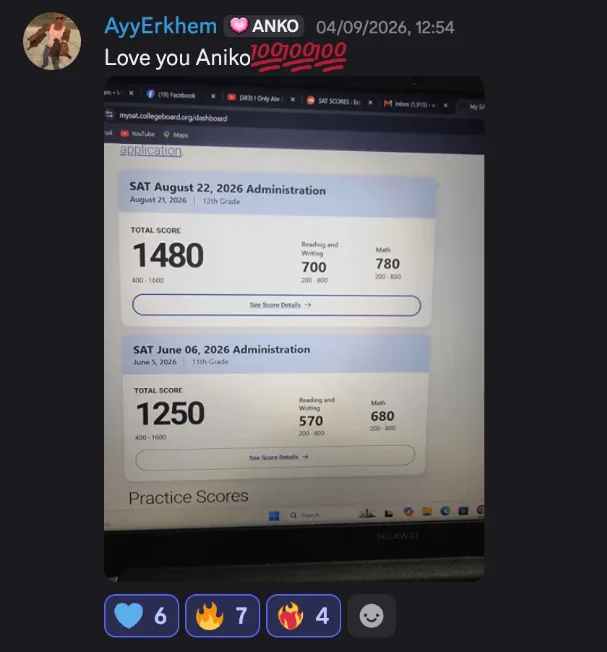
- Reading and Writing: 570 to 700, up 130
- Math: 680 to 780, up 100
- Total: 1250 to 1480, up 230
The surprise is which section moved most. Ay came for Math. He wanted at least 750 in Math, which he says would count as a full 800 on the GEE, Mongolia's university entrance exam, but Reading and Writing gained more: 130 points to Math's 100.
If English is your second language and you're stuck in the 500s or 600s, you've probably been told to read more novels or learn 500 new words. Ay did neither. He answered 2,217 Reading and Writing questions on Aniko. He fixed a few grammar rules first, and he learned the exact meanings of words he already knew.
Good English wasn't his problem, and it may not be yours. The SAT rewards a handful of rules and precision with ordinary words. Here's how he fixed both, in his own study data.
Grammar first: the fastest points
If you're taking the SAT on December 5, time is short. Two weeks is what grammar took him.
A week in, his practice test still gave him 580 in Reading and Writing, about the same as his 570 in June. Nine days later, a practice test gave him 690. His Reading and Writing estimate climbed with it, from 660 to 740 in two weeks. The line is his estimate, and each cross is a full practice test or a real SAT. Switch to Total to see both sections.
Ay's score estimate from June 27 to his August SAT, from his Aniko profile. The crosses are his full practice tests on Aniko and his June and August SATs; ▲ is the gain from his first estimate, on June 27.
So what changed in those two weeks? Grammar. Here are three of his skills, his first 12 days beside the next two weeks:
- Boundaries65% → 84%Jun 27 – Jul 865% of 96Jul 9 – Jul 2284% of 62
- Form, Structure, and Sense67% → 82%Jun 27 – Jul 867% of 63Jul 9 – Jul 2282% of 62
- Words in Context65% → 56%Jun 27 – Jul 865% of 71Jul 9 – Jul 2256% of 63
Boundaries went from 65% to 84% right, on questions just as hard as before. Boundaries asks where one sentence ends and the next begins: periods, semicolons, commas. Form, Structure, and Sense, the verb and pronoun questions, went up too. Words in Context went down, on harder questions than before. The gains were in the rules.
It held on the full tests. In the grammar domain, Standard English Conventions, he got 10 of 14 right on his first practice test and 14 of 14 on August 8.
The rule that pays most is short: a semicolon does a period's job. Use one only where a period would also work, with a full sentence on each side. A comma alone can't join two sentences, and words like for example or however don't join them either. Ay missed this one on July 31 and got it right on August 20, two days before his SAT. Try it:
Try one: the network logs
Cybersecurity analysts often review network logs—records of connection attempts and data transfers—because they reveal patterns of activity. These logs can be ______ repeated login attempts from the same IP address may indicate a brute-force attack.
Which choice completes the text so that it conforms to the conventions of Standard English?
Worked solution
Cover the transition and split at the blank. These logs can be revealing has a subject and a verb: a full sentence. Repeated login attempts from the same IP address may indicate a brute-force attack has its own subject, attempts, and its own verb, may indicate. Another full sentence.
Two full sentences need a period or a semicolon (or a comma plus and, but, so). For example is not a joining word, so the commas around it in B still leave a comma splice. A has a comma alone, and D has nothing at all.
C puts the semicolon between the sentences and a comma after for example, which opens the second one. C. revealing; for example,
Ay picked B the first time, like more than a third of students. The full rule, with every way two sentences can meet: Joining two sentences. For the rest of the grammar, start with our SAT grammar tips. More questions like it: 50 hard SAT grammar questions.
The words he knew, read precisely
Words in Context was Ay's hardest skill all summer. But look at what he got wrong. They weren't rare words he'd never seen. They were words he knew, used in a meaning he didn't expect:
Words he knew, meanings he missed
“Celia’s resolve did not waver.”
he readsolutionit meantdeterminationright 5 days later“a disinterested scholar … someone with no ties to Hart, her rivals, or the publisher”
he readlacking curiosityit meantfree from self-interestmissed 4 times“details that subtly ______ the credibility of that portrayal”
he picked?missed twice. your turn ↓
Three Words in Context questions Ay missed on Aniko this summer, and the answers he chose for two of them.
Resolve usually means a solution to you. Here it means determination: Celia's resolve did not waver. Disinterested sounds like bored, but it means having nothing to gain, and the text says so right after the dash: no ties to anyone involved. The clue was in the sentence both times.
There's a subtler kind of miss. Two choices point the same way, and only one fits exactly. This one beat Ay twice. Try it:
Try one: the painter’s notebooks
Critics often presented painter Lina Ortega as an effortless prodigy. Her private notebooks, however, describe painstaking revisions and frequent doubts—details that subtly ______ the credibility of that portrayal.
Which choice completes the text with the most logical and precise word or phrase?
Worked solution
Find the contrast. The critics say effortless; the notebooks say painstaking revisions and frequent doubts. So the notebooks push against the critics' picture.
Read what the verb acts on: the credibility of the portrayal, how believable it is. The details make it less believable, and subtly, so they weaken it without proving it false.
Check each word's exact meaning. Contradict means to say the opposite of a claim, but credibility isn't a claim you can say the opposite of. Exhibit (show) and perpetuate (keep going) point the wrong way. Undermine means to weaken. B. undermine
Picked one? The trap here caught more students than the right answer. Both push against the critics, so look at what the blank acts on, credibility, and pick the word that does exactly that job to it. Our lessons on precise words and words with more than one meaning teach both traps. More questions like it: 25 hard SAT Words in Context questions.
Here's the habit that replaced a word list for Ay: he went back to his misses. Aniko brought his misses back in Review Labs, and the Error Log let him retry each one. Of the 61 Words in Context questions he got wrong the first time, he tried 57 again and got 45 right in the end. Each miss became a word he now knows in its SAT meaning, with the sentence that taught it.
And here's the relief. The hardest Words in Context questions never got easy for him. Of the ones Aniko labels Hard, he got about half right all summer: 78 of 153. The Medium ones went from 54% right in his first 12 days to 76% after. He reached 700 without beating the hardest words. The points came from the medium ones, the grammar and everything around them.
A plan with no excuses, and the swings on the way
Ay is honest about himself:
I am a person who procrastinates a lot, so a fixed schedule with a list of all the things I need to do was very helpful.
It was summer break, with no school work, so he had his study plan built for 2 to 3 hours a day. On the days he didn't feel like it, the plan left him nothing to argue with:
On Aniko, since all the things I needed to do were right there, ready on the screen, I couldn't find excuses.
He studied 50 days in a row, from June 27 to August 15, about 75 questions a day. Studying with Aniko, he says, felt like playing a video game.

The path wasn't smooth. On July 13 he scored 1480 on a full practice test, his first over 1400. Three days later, he scored 1330. His last practice test, four days before the SAT, gave him 1410. On August 22 he scored 1480.
If your last practice test came in low, one test is one day. His last four full tests averaged 702 in Reading and Writing, and the SAT gave him 700. His last estimate before it, on August 18, said 1500:

Twenty points off. Ay's only regret: “I felt a little sad because a 1500 was so close, hahaha.” His first estimate, after the diagnostic, was 1300, which he calls “pretty spot on, after taking into account the nerves.”
And the night before the test, he kept it simple:
Get into bed early, not too much cramming, and mental rest.
What our numbers say for students like him
Ay isn't the only one. We looked at students whose first SAT had Reading and Writing under 600 and who took the SAT again. The ones who answered 500 or more Reading and Writing questions on Aniko before their next SAT gained a typical 75 points in Reading and Writing. The ones who answered fewer than 300 questions gained 30.
Students whose first SAT had Reading and Writing under 600
- Answered 500+ Reading and Writing questions on Aniko between their SATs (36 students)+75 points
- Answered fewer than 300 questions on Aniko (572 students)+30 points
- Ay, June to August+130 points
The typical change in Reading and Writing from their first SAT to their next one. Typical is the median: half went up more, half less.
Both groups started under 600. The students who practiced more moved further, and Ay, with 2,217 Reading and Writing questions, moved further still.
What you can take from him into the weeks before your SAT:
- Fix the grammar rules first. They're few, they come back on every test, and they moved his score fastest. Start with where sentences end.
- Your misses are your word list. Go back to every Words in Context question you missed, and learn the word with the sentence it came in.
- Read for the exact meaning, not a rare word. Most traps are words you know, in a second meaning or a slightly different job.
- Let a plan decide your day. Then there's nothing to argue with.
- Sleep before the test.
- Don't panic over one low practice test. It's one day.
Already on Aniko? Open your Error Log and retry every Words in Context question you missed.
Want explanations in your own language? See Can I study on Aniko in my language?
Ay's advice for students starting now is short: be consistent. From 570 to 700, one rule and one word at a time. Well played, Ay.
Got your November score? Post it in the Aniko Discord, where Ay posted his.