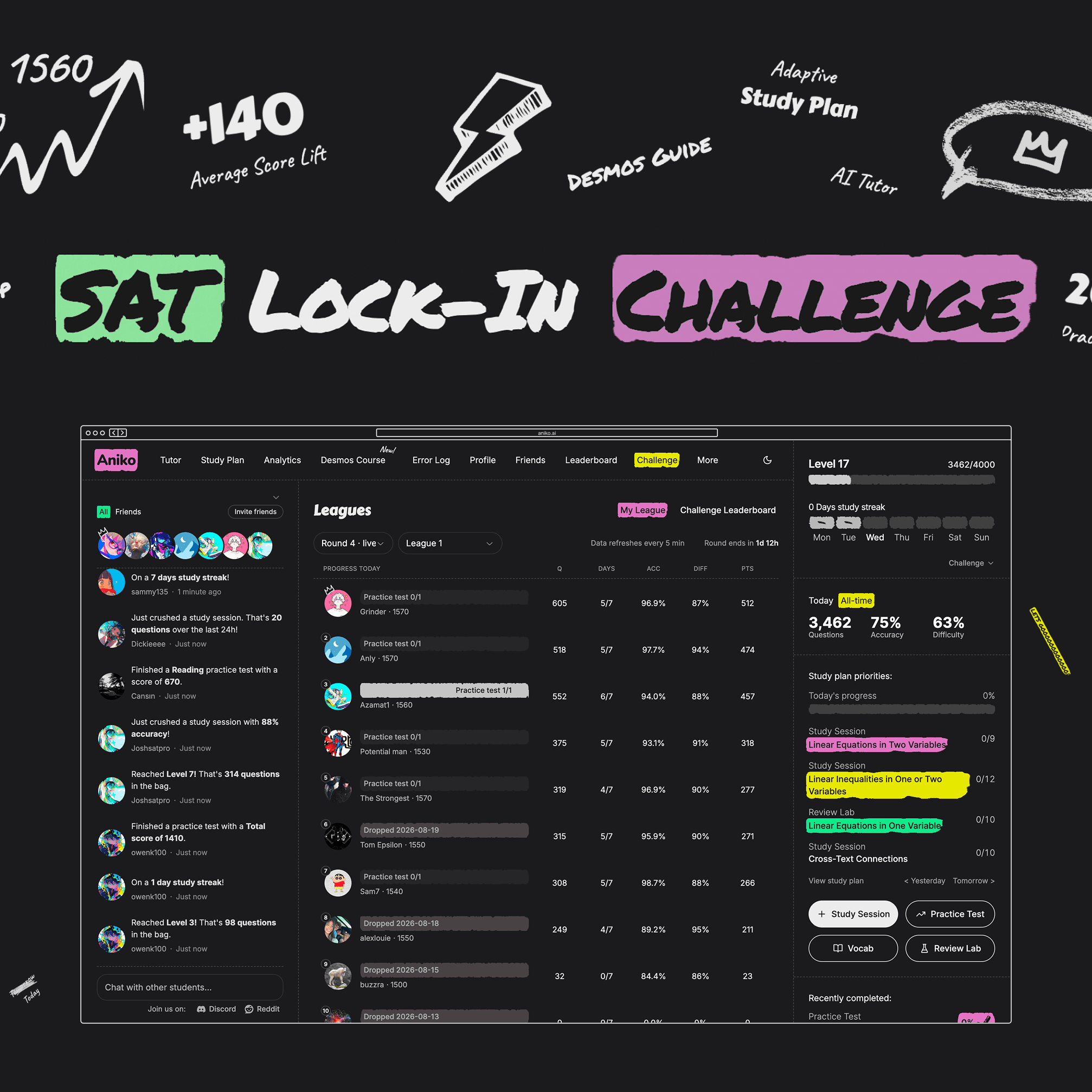
Consistency is the hardest part of SAT prep. Most students know they need to study. The challenge is doing it every day.
We built the SAT Lock-In Challenge to make students want to come back. Every student gets a personalized plan, a clear task for today, a way to see progress, and a reason to return tomorrow.
98 minutes
Average daily study time on Aniko for a Top 30 student
5.0 out of 5 experience
87 minutes
Average daily study time on Aniko for a Top 100 student
4.9 out of 5 experience
79 minutes
Average daily study time on Aniko for a Top 500 student
4.7 out of 5 experience
Those minutes go into real SAT practice: hundreds or thousands of questions, in long focused sessions. Across three Challenges, that work produced individual Aniko score estimates as high as 330 points.
10 remarkable score gains across this summer's SAT Lock-In Challenges











The largest featured gain belongs to adrian_, who climbed from 1080 to 1410. TaguekaDaniel moved from 1110 to 1410. Every student in this summer's Top 10 gained at least 220 points.
“So seriously, if you have the opportunity, lock in. Stop switching methods every week. Just follow the study plan and stick with it. Everything else I tried didn't come close to this.”
Ethan reported gaining more than 300 points after one week of following his plan in his original post.
Three Challenges, one repeating pattern
The first Challenge established the pattern. Students averaged 94 focused study minutes per day and kept returning to protect the progress they had built. Jokes described the shift simply: "The challenge forces you to realize that tomorrow doesn't count." Read his complete story.
The second Challenge introduced weekly Leagues, giving students meaningful competition near their own level. The Top 20 averaged 2,285 questions and 48.6 focused study hours per student. Justin showed the value of that structure: one missed day did not end the habit. He came back and won. Read his complete story.
The current Challenge proves that experience at a much larger scale. On each day they study, a student in the Top 30 averages 98 focused minutes. The Top 100 rates the experience 4.9 out of 5. Even the Top 500 averages 79 focused minutes and rates the experience 4.7.
Current Challenge Top 10: study time and questions answered
Average focused time per study day and total questions through August 19









The format kept improving. The student experience stayed consistent: long sessions, repeat study days, visible progress, and rising scores.
The pattern continues through the Top 500
The current Challenge gives us the clearest view yet because we can compare the same study behavior across five large groups. These are per-student averages as of August 19.
Top 30
98 minutes
on each day they studied
- 2,190 questions
- 81.0% accuracy
- 42.6 focused hours
- 26 active days
Top 50
94 minutes
on each day they studied
- 2,080 questions
- 80.1% accuracy
- 39.7 focused hours
- 25 active days
Top 100
87 minutes
on each day they studied
- 1,725 questions
- 79.0% accuracy
- 32.4 focused hours
- 22 active days
Top 250
83 minutes
on each day they studied
- 1,114 questions
- 77.6% accuracy
- 20.9 focused hours
- 15 active days
Top 500
79 minutes
on each day they studied
- 673 questions
- 75.8% accuracy
- 12.6 focused hours
- 10 active days
The session length stays high across every group. The Top 30 averages 98 focused minutes each time they study. The Top 500 still averages 79 minutes.
The biggest difference is consistency. The Top 30 studied on 26 days. The Top 500 studied on 10. Students near the top combined long sessions with a strong daily habit.
Individual score gains across all three Challenges
The opening table brings together ten remarkable gains from all three Challenges this summer, ranging from 220 to 330 points. See the published first Challenge results. The next two tables show how the pattern kept repeating.
Second Challenge







Mufliha climbed from 1190 to 1470 while answering almost 3,000 questions. Khing and Grinder both reached 1510 from 1310 through very different study volumes. These ten students gained between 140 and 280 points.
Current Challenge



All ten featured students gained at least 200 points. Their starting estimates range from 840 to 1270, and their study volume ranges from 846 to 2,490 questions. The same game loop supported different students, starting levels, and study patterns.
What students say when the loop starts working
The numbers tell us what students did. Their own words explain why they kept doing it.
Another student later shared an official 90-point SAT increase after using the Challenge as the core of one month of preparation.
“I managed to boost my score in about 1 month by doing the lock-in challenge before the June SAT.”
For Zyalpze, the measurable leaderboard became an anchor. His first diagnostic was 1190, and his estimate climbed into the 1450 to 1500 range.
“The measurable scores calculated through the product of accuracy, difficulty, and number of questions were the highlight of the challenge for me... The rewards of “lifetime Premium” and $25 were secondary; the experience is the main prize I got from this challenge.”
Namtham described the social effect in simple terms. Daily progress from other students replaced passive scrolling with a reason to begin.
“I think posting daily screenshots is a good idea; it motivates you to start doing something instead of sitting and scrolling. Why do that when people are trying their best anyway?”
A 4.7 out of 5 experience across the Top 500
Have you ever seen a student study for 90 focused minutes, rate the experience 4.9 out of 5, and come back the next day?
We achieved that pattern across the current Top 100. They average 87 focused minutes per study day and have studied on 22 days. They rated the experience 4.9 out of 5.
- Top 100: 4.9 out of 5
- Top 250: 4.7 out of 5
- Top 500: 4.7 out of 5
These students completed long sessions, demanding daily targets, and repeated full-length tests. The game made that work clear, visible, social, and rewarding. Students studied for long, focused sessions, enjoyed the experience, and kept coming back. Across three Challenges, we achieved it with thousands of students.
The game loop behind the results
1. Personalized quests
Every student receives assigned work based on current mastery and weak areas. The goal is concrete: complete today's plan. There is no time lost deciding what to study next.
2. Immediate progress
Questions, accuracy, mastery, focused time, scores, and ranks all move while the student works. A distant SAT result becomes a sequence of visible wins.
3. Streaks and lives
Streaks give the habit something visible to protect. Lives add stakes while leaving room for a difficult day. Students have a reason to return and rebuild.
4. Leagues and levels
Small Leagues create competition close enough to feel meaningful. Students compete near their current mastery level, and weekly movement creates a sense of advancement.
5. Leaderboards, profiles, and status
Avatars, ranks, crowns, badges, and public profiles make achievement part of a student's identity. Progress is visible, and every student can see peers working toward the same goal.
6. Social accountability
A daily Discord post is a required part of the Challenge. It builds consistency, discipline, and the habit of studying together. Shared screenshots, standings, peer activity, and conversation show that other students are doing the work too. Effort becomes contagious.
7. Real rewards
Cash makes the competition exciting and the achievement immediate. Lifetime Premium makes achievement durable. Score improvement is the lasting reward.
As we explained in the story of why we built Aniko, we see our son in every student. Like any parent, we want hard work to lead to a moment a student can really feel.
“It’s easier to focus and stay consistent when you have fun and when you see the results and see that the effort pays off. You want to do more of that.”
The leaderboard rewards useful work. Questions, accuracy, and difficulty all matter. As we tell students: "You can't farm easy questions to climb, and you can't coast on five perfect questions a day either. You have to do the work."
Game mechanics built around learning
Points and badges are the surface. The SAT Lock-In Challenge connects every part of the game to a useful study behavior:
- Daily quests create clarity.
- Personalized difficulty creates useful effort.
- Immediate feedback accelerates learning.
- Streaks create repetition.
- Lives create resilience.
- Leagues create fair competition.
- Public progress creates accountability.
- Peer activity creates belonging.
- Rewards create stakes.
- Score movement connects the game to a real-world goal.
Video games and social platforms know how to hold attention. We can use the same design skills to help students practice, understand, stay consistent, and improve. Serious studying can be engaging enough to compete with everything else demanding a student's attention.
Students who want the full learning system outside the competition can follow the complete Aniko study loop: diagnose, follow the plan, solve carefully, review, target weak areas, test, and repeat.
Every student gets a real chance to play
A family's budget should never decide whether a student gets a serious chance to improve their SAT score.
During the Challenge, students who cannot afford a subscription receive 500 questions and 10 practice tests every week at no cost. That is enough to complete the full Challenge workload, compete for cash prizes, improve their score, and earn lifetime Premium.
This makes the SAT Lock-In Challenge accessible to every student. We chose to put our budget directly into access and rewards for students.
“Instead of spending money on ads, we decided to do something crazy. Let's spend money on students instead to motivate them to study even more.”
Ethan's story shows why this matters. He reported major progress while studying without Premium. Expanded Challenge access gave him the room to follow his plan and compete alongside everyone else.
Challenge FAQ
These are the questions students ask Aniko most often, combined with the rules from the Challenge page. After you join, the live Challenge FAQ has the same answers with details for your run.
Answer at least 50 questions from tasks assigned in your Aniko study plan, complete the required full-length practice tests, and post your progress in #lock-in-challenge on Discord. Complete at least one full-length test each week. In the current Challenge, the final round replaces that weekly test with one full-length test on each of the last three days.
The Discord post is a required part of the Challenge. The Challenge page shows whether today is locked in.
Only questions from tasks assigned in the study plan count toward the 50-question minimum: today's scheduled work, catch-up from the previous two days, and limited work-ahead from the next two days.
Manually started sessions, tasks you add yourself, older backlog, and Bluebook tests you take outside Aniko do not count toward the minimum, even though they still help you learn. This is the question students ask Aniko most often, usually after a long session that did not move the Challenge counter.
On a full-test day, a completed Aniko full-length practice test satisfies the requirement. If you complete more than one that day, only the first full test you started contributes questions and points.
Extra eligible plan questions still count for points. The ranking formula is questions × accuracy × difficulty, so more careful work can move you up the leaderboard. "Done for today" means the daily minimum is met. It does not mean extra plan questions stop scoring.
You cannot bank extra credit for tomorrow. Each calendar day, in your local timezone, needs its own minimum. You can work up to two days ahead only while that future day would still have at least 50 questions left afterward. If you know a busy day is coming, do a short session on that day itself.
If today's plan looks short, you probably finished some of tomorrow's tasks last night. Those questions counted yesterday, not today. Raise your daily question count in Settings if you need more assigned work for the day in front of you.
Missing a required day drops you from your current run and uses one of three lives for the week. If you still have lives, you can rejoin while the Challenge is active. Lives refresh at the start of each weekly round, so a tough week does not knock you out for good. The current Challenge has four weekly rounds.
Justin missed a day in the second Challenge, came back, and won. Read his complete story.
If you join with more than three hours left in the day, you choose whether your first required day is today or tomorrow. With three hours or less left, your first required day is tomorrow. If you join before the Challenge officially starts, your first required day is the Challenge start date.
Each week you are placed in a league of about 10 students at your level and ranked by questions × accuracy × difficulty. Volume alone does not win it. Finishing place earns placement points, from 10 for first to 1 for tenth, scaled by the Challenge days you completed that round. Those points stack on the Challenge leaderboard and decide prizes.
If placement points are tied, the student who earned points in more rounds ranks higher. Cumulative Challenge score breaks the remaining tie.
Yes, you can still win from a lower starting score. Your plan adapts to your level, so difficulty is measured against your own ability. A student who shows up carefully can outrank a higher-baseline student who skips days or rushes. Leagues exist so the climb stays winnable no matter where you start.
In the current Challenge, cash goes to the top 10: $120, $90, $70, $55, $40, then $25 each for sixth through tenth. The top 20 receive lifetime Aniko Premium.
The lasting prize is the score you take into the SAT. Cash makes the competition exciting. The habit is what stays.
Yes. Students who cannot afford a subscription receive 500 questions and 10 practice tests every week at no cost, while a free spot is still available. The grant activates when you join.
Limits are weekly, so burning through them in one sitting can leave you short later in the week. If you drop out, the grant reverts and the spot opens for someone else.
The settings that protect the Challenge stay locked. You cannot turn off Math or Reading and Writing domains, remove study days, set your daily question count below 50, lower the number of weekly full-length tests, or move your SAT date to before the Challenge ends.
You can add more daily questions, add more practice, or push your test date further out. A locked change drops you from your current run and uses one life.
Set your daily study-plan target to the highest number of questions you can sustain every day, not your best day. Show up, complete the assigned work, and prioritize accuracy over volume.
The real win is the score you put up on test day. The Challenge exists to make that prep more consistent. Play it that way and you win either way.
Yes. A daily post in #lock-in-challenge on Discord is a required part of the Challenge. It builds consistency, discipline, and the habit of studying together.
Share a screenshot, a summary, or a question from the day's work, then check in on the Challenge page. Cheer for other students doing the same.
Our priority is to keep the Challenge fair for everyone. We run automated fair-play monitoring throughout the competition and disqualify students who try to cheat.
The proven system continues
Three Challenges have proven that the system works.
When studying becomes visible, personalized, and social, students do extraordinary amounts of difficult work. They answer thousands of questions. They study for weeks. They help one another keep going. They raise their scores. Across the Top 500, students rate the experience 4.7 out of 5.
The current Challenge runs August 23 through September 10.
Three Challenges have shown us the direction. The mechanics that make games and social platforms engaging can also make education more consistent, more social, and more effective.
The leaderboard is the game. Your SAT score is the final boss.