In December 2025, Namtham's SAT came back at 1450: 790 in Math, 660 in Reading and Writing. Every point he had left was in one section.
Six months later, he scored 1540, with a perfect 800 in Math and 740 in Reading and Writing. In the Lock-In Challenge right before the test, he answered 1,689 study plan questions at 95% accuracy and finished second of 426 students.
He had started SAT prep at around 1300. Here is the routine that moved his Reading and Writing 80 points, shown in his own study data: short blocks of practice on his weak skills, and every mistake met again the same day. And here is why he now helps other students build it.
1540 on June 6
Namtham sat the SAT on Saturday, June 6, 2026. On June 22, he posted his score in the Aniko Discord, with one line under it:
“One of the biggest wins of my life.”
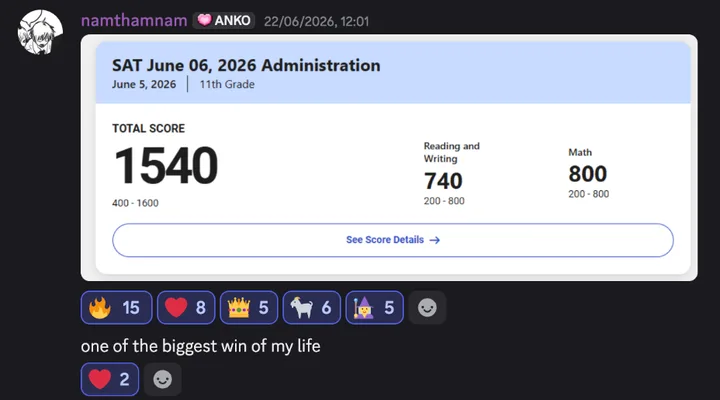
- Reading and Writing: 740, up 80 from December
- Math: 800, a perfect score
- Total: 1540, up 90 from December and about 240 from where prep began

The 80 points in Reading and Writing are the story. They came from the one section that had been holding the score back. Here is how he got them.
Full modules weren’t working
Namtham is an international student. In June 2026 he was in 11th grade, with an IELTS exam planned right after the SAT.
His first months of prep looked like most students' prep: full practice modules, one after another.
I used to practice with full modules only, which is really bad since you can't target your weak points, and reviewing your mistakes is tedious without a clean tool.
A full module feels like real work. But it gives you a few questions from each skill, and most are ones you already get right. A weak skill shows up once, and then the module moves on.
The score still went up. A December 2025 SAT came back at 1450. Math was almost done at 790. Reading and Writing was at 660.
His first month on Aniko
Namtham joined Aniko on February 23, 2026, with his SAT set for June 6 and a target of 1600. His study plan put practice where the most points were at stake: the skills he hadn't mastered yet. For Namtham, that meant Reading and Writing.
His first score estimate, on March 2, was 1490. By the end of March, it was 1550. Here is his estimate up to test day, with his official scores on it. Switch to Reading and Writing to see where it moved.
Namtham's score estimate from March to June 2026, from his Aniko profile. The dots are his December and June SATs and a Bluebook practice test.
10 questions, a Review Lab, 10 questions
This is the part you can copy. He never did all his questions in one block:

“10 questions, Review Labs, 10 questions, 5 similar questions to the ones I got wrong (if any), 10 questions... until I finish it all.”
Every 10 questions, the mistakes come back. A Review Lab brings back questions you missed or bookmarked. Similar Questions builds a short set of new questions on the same idea as one you got wrong. Namtham picked 5, so he found out right away whether he had fixed it.
That's the difference from full modules. A mistake doesn't wait in a notebook for weeks. You meet it again within minutes, while you still remember why you picked the wrong answer.
He put his strategy in one sentence: be consistent, actually understand why you got a question wrong, and manage your pace.
Not every day was a big day
Here is every day Namtham studied on Aniko, from February to the day of his SAT. The darker the square, the more questions he did.
Number of questions answered per day.
Most days were 15 to 60 questions. A few were over 150. In March, a full practice test dropped his Reading and Writing estimate by 40 points.
In late April, he took 10 days off. Then he came back, and from May 19 every day was a big day.

Looking back on the year, Namtham put it simply:
It was tough at times, yeah, but I feel good since I can share my feelings with my new friends on the Aniko Discord server.
The worst days were practice test days:
I hate focusing for too long without breaks, but that is really necessary, ngl.
He took them anyway. On May 23, two weeks before the SAT, he scored 1550 on an official Bluebook practice test: 790 in Math and 760 in Reading and Writing.

The Lock-In Challenge
On May 19, Namtham started the SAT Lock-In Challenge: at least 50 study plan questions every day until June 4, two days before his SAT, with daily screenshots in the community. His goal was “improving my reading skill and staying consistently above 1500.”

My motivation is the fact that the test is 3 weeks away 💀, so even if I don't want to, I need to study.
He did far more than 50. Most days were 90 to 120 questions, and two were over 140. By the end, it was 1,689 study plan questions at 95% accuracy, and second place out of 426 students. He didn't lose a single life.
The daily screenshots helped too:
I think posting daily screenshots is a good idea; it motivates you to start doing something instead of sitting and scrolling. Why do that when people are trying their best anyway?
His biggest win from those 17 days was speed. On test day, pacing matters as much as knowing the answer, and doing about 100 questions a day builds it. The challenge ended on Thursday, June 4. He took Friday off, and on Saturday morning he sat the SAT.
From student to tutor
After his SAT, Namtham joined Aniko as a tutor and community moderator. The student who lost no lives in the challenge now helps other students keep their streaks, work through the questions they miss and reach their dream score.
His advice from the challenge interview, given in June as a student, is what he now tells other students:
“Chances are you've gotten through 90% of the difficult part just by locking in for once.”
What you can take into your next session
- Practice your weak skills, not full modules. Full modules are for practice tests. Daily practice should go where your points are.
- Meet every mistake again the same day. After every 10 questions, run your misses through Similar Questions or a Review Lab.
- Keep showing up, and lock in at the end. A light day still counts. In the last weeks, make every day a big one, and post it where friends can see.
Hope all of you get your dream scores!
That was Namtham's last line in June. Now he helps students get there, one session at a time.