Every SAT question you answer should make the next one more useful. You should know what improved, what is still holding your score back, and exactly what to work on next. That is what Aniko is built to do. When you use its diagnostic, study plan, AI tutor, practice, and analytics as one connected system, SAT prep becomes a clear path toward your best score.
Aniko learns from your work. Every completed Study Session and practice test sharpens its understanding of your strengths, weaknesses, timing, and mastery. Your plan adapts. Your score prediction becomes more precise. The next task reflects what will help you most now, not what was useful two weeks ago.
This guide shows you how to make that system work at its full potential.
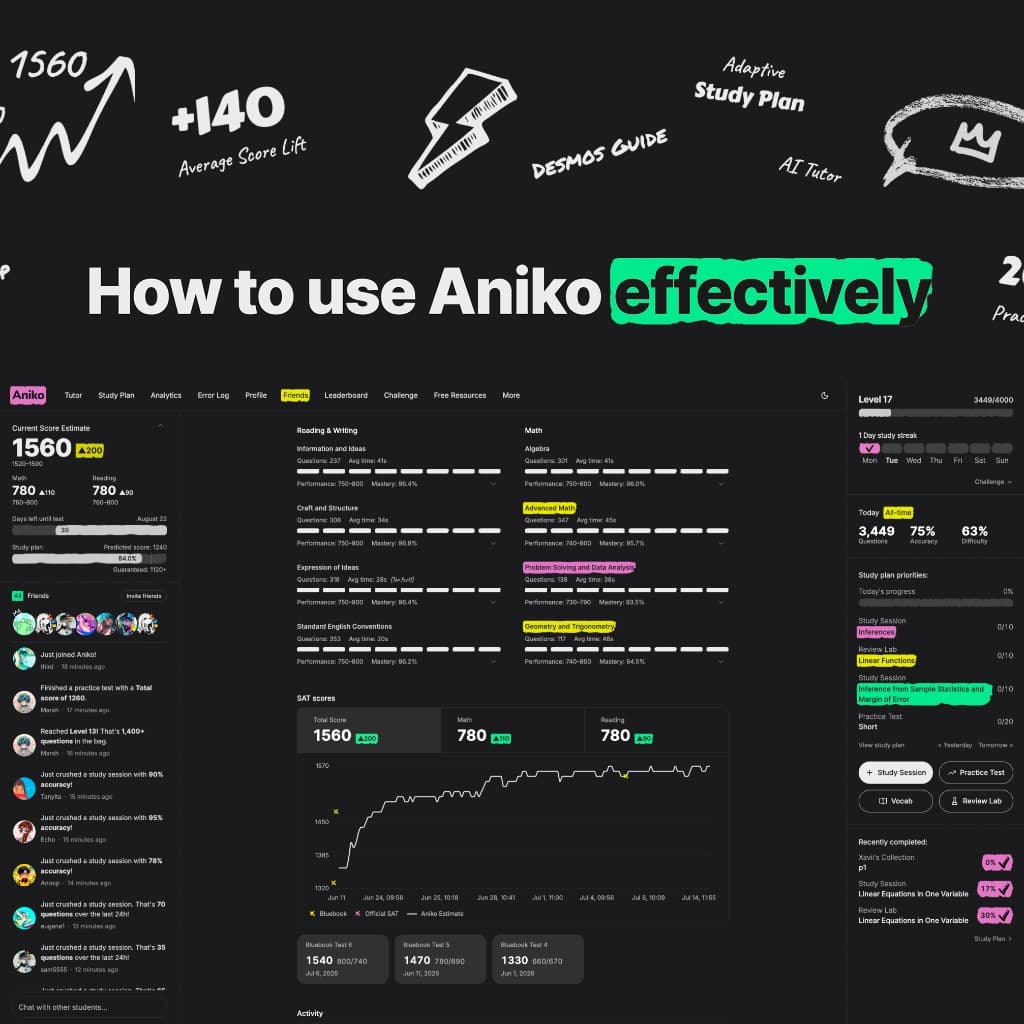
How Aniko turns practice into progress
The most effective way to use Aniko is simple:
- Diagnose your current level.
- Configure your goal and schedule.
- Follow your personalized study plan.
- Solve carefully and review every mistake.
- Reinforce weak skills with Similar Questions and Review Labs.
- Read your analytics.
- Take a full practice test each week.
- Stay consistent.
Each step makes the next one smarter. Skipping the review or ignoring the plan weakens the entire system. Following it turns every Study Session into measurable progress.
1. Start with a diagnostic test
Your first job is to give Aniko an honest picture of where you are.
The best starting point is a full-length practice test. It gives Aniko broad evidence across Reading & Writing and Math, establishes your first score estimate, and reveals the domains and skills that hold you back. You also experience the full digital SAT structure from the beginning.
Set aside enough time, work without outside help, and treat the result as useful data. A lower starting score is not a setback. It gives Aniko more clarity about how to raise it.
If you do not have time for a full test yet, complete the shorter onboarding diagnostic. For a balanced plan, this consists of 12 Reading & Writing questions and 12 Math questions. Students focusing entirely on one section receive one 20-question diagnostic instead. This gives Aniko enough information to build your initial study plan, and you can complete a full test once you are ready.
2. Configure a study plan you can follow
Once Aniko understands your starting point, tell it where you want to go and how much time you can genuinely commit.
Set:
- Your SAT date
- Your target score
- The days you can study
- The amount of work you can complete on those days
- Your balance between Reading & Writing and Math
- How often you want to take full practice tests
Be ambitious about the result and realistic about the schedule. A plan you complete consistently is far more powerful than an extreme plan you abandon after three days.
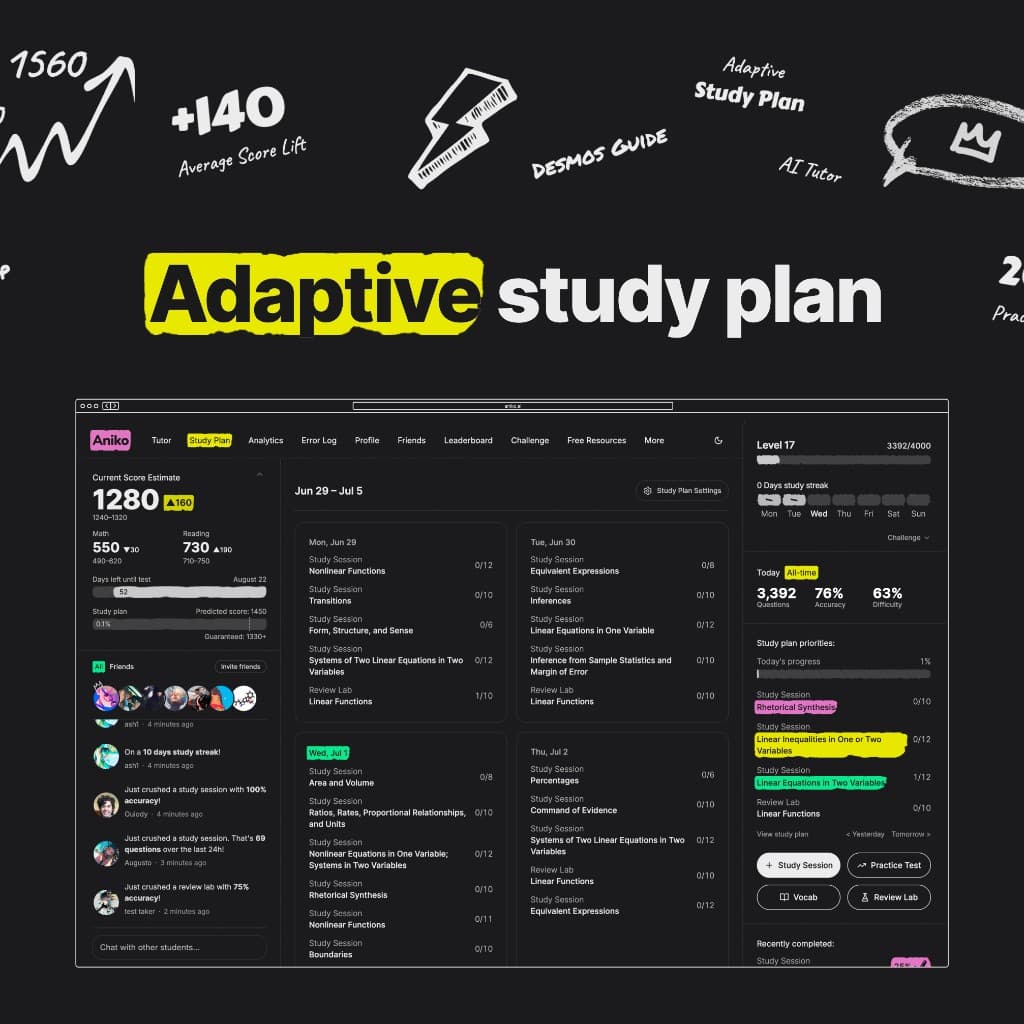
Aniko builds your plan around your score gap, weak domains, recent mistakes, available time, and test date. It gives you only the next few days of tasks because the plan is alive. As you turn weaknesses into strengths, Aniko changes what comes next. You are never trapped in a static calendar created from old data.
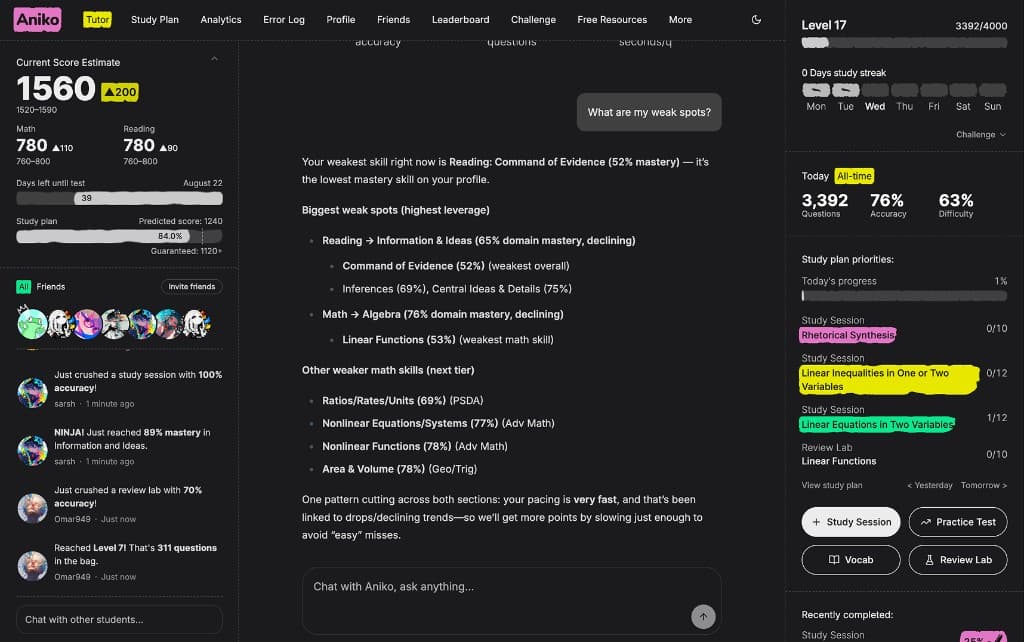
Your plan is the center of the experience. Start from Study plan priorities and complete the recommended task before creating random practice. The plan already knows which skill needs attention and how that work fits into the larger path toward your goal.
“It takes a lot of the guesswork out of what to study and tells you what your weaknesses are bluntly.”
Read how Ologist used Aniko to move from 1440 to 1500.
You can change your schedule, test date, intensity, or section focus in your study plan settings. If you are unsure what to change, ask Aniko. She knows your plan and analytics and can guide you through the decision.
3. Use every Study Session well
A Study Session is more than a set of questions. It is a focused lesson built around a specific weakness or goal.
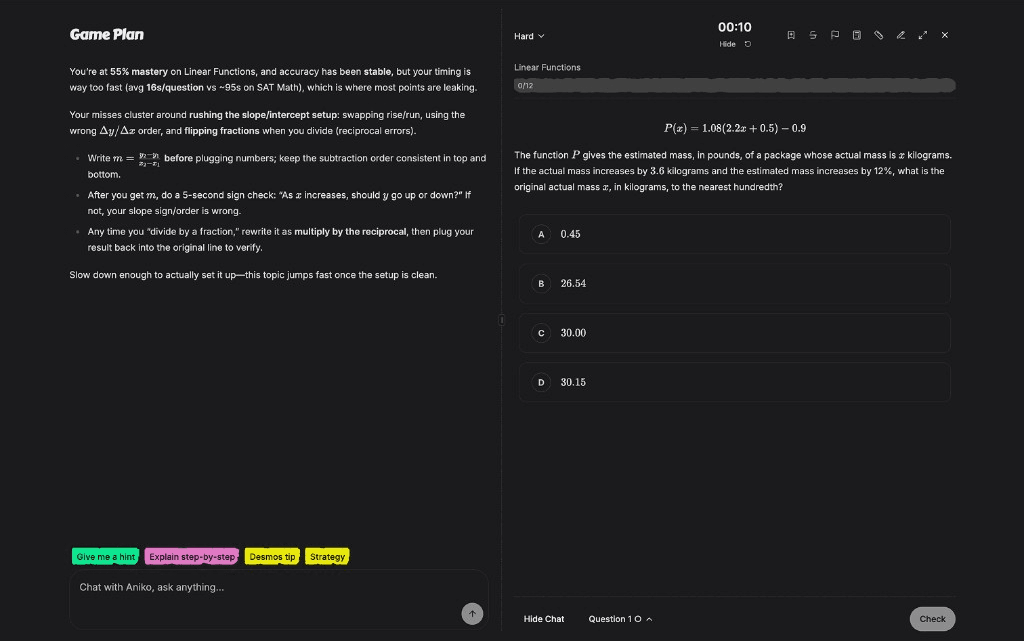
Read the Game Plan first
When a session contains more than five questions, it begins with personalized study guidance. Read it before opening the first question.
Aniko looks at your recent performance and tells you:
- What the session is designed to improve
- Which patterns to recognize
- Which mistakes to avoid
- What to focus on while solving
This guidance gives purpose to the session. Keep it in mind as you work instead of treating each question as an isolated problem.
Choose accuracy before speed
Until your mastery of a skill is strong, accuracy matters more than speed. Rushing the wrong approach only teaches you to repeat the same mistake quickly.
As a practical rule, build the skill above 80% mastery before making timing the main goal. First learn to recognize the question type, choose the right approach, and execute it reliably. Then train yourself to do the same work faster.
Attempt the question before asking for help
Give yourself a real chance to solve each problem. The effort of choosing an approach is part of the learning.
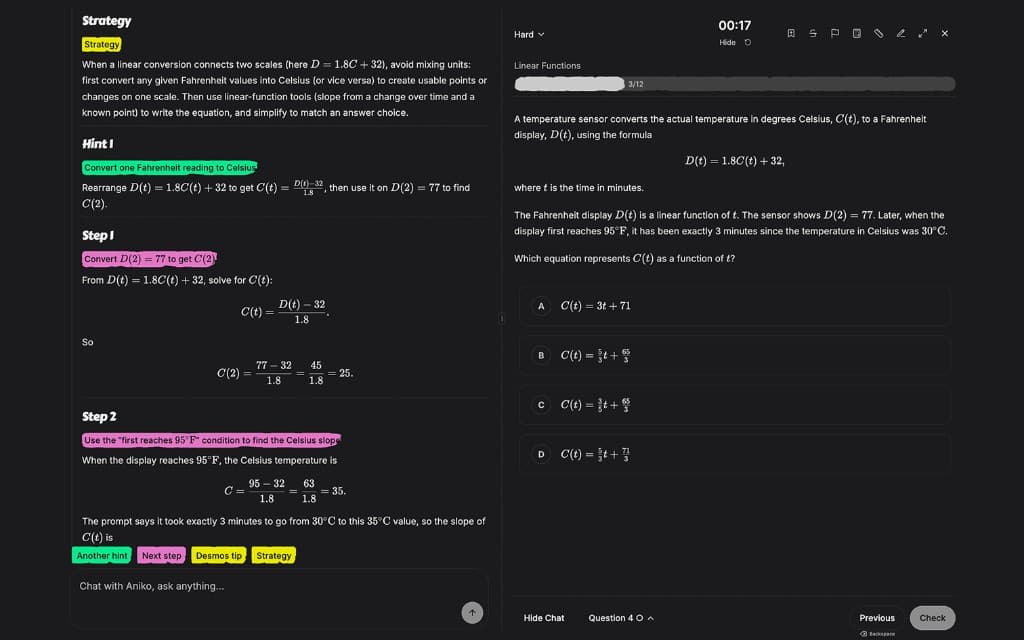
When you get stuck, use the support that matches the problem:
- Hint for a small nudge
- Strategy for the right overall approach
- Step-by-step when you need the solution broken into smaller moves
- Desmos tip for guidance on solving it with the calculator
- Ask Aniko when your confusion is specific or the written explanation is not enough
Aniko knows the exact question you are solving, your strengths, your weak spots, and the mistakes you commonly make. Ask follow-up questions in your own words. She will guide you without revealing the answer.
Use the other tools too. Elimination mode helps remove answers you know are wrong. The highlighter keeps important phrases visible in long passages. The built-in Desmos calculator lets you practice with the same calculator available on the digital SAT, and the free SAT Desmos course teaches you how to use it.
4. Turn every mistake into a stronger approach
A correct answer confirms what you know. A mistake shows you exactly where your score can grow.
Do not rush past it. Read the explanation and answer four questions:
- What was the question really testing? Start with the overview.
- What is the most reliable solving strategy? Learn the pattern that tells you which approach to use.
- Why were the other answers wrong? SAT distractors are designed around predictable mistakes. Learning their logic makes them easier to spot next time.
- Can you reproduce the solution yourself? Follow the steps, then explain the reasoning in your own words.
“The main problem I have with most resources is that they can tell you the right answer, but can't fix your method to getting that answer.”
Aniko is built to improve the way you solve.
Use Similar Questions immediately
After reviewing a mistake, open the similar SAT questions feature. Aniko finds similar questions that use closely related concepts and solution patterns.
This is where understanding becomes reliable. You are not memorizing the answer you just saw. You are proving that you can recognize the same pattern in a new form and apply the better approach without help.
Do not stop after one lucky correct answer. Repeat the process until it feels familiar.

Save questions worth revisiting
Bookmark questions that taught you something important, exposed a recurring mistake, or used an approach you want to remember. Group related questions into collections such as:
- Hard quadratic questions
- Transitions I keep missing
- Desmos techniques to practice
- Tricky inference questions
You can restart any collection as its own Study Session and share it with other students.
Use Review Labs to close old gaps
A Review Lab creates targeted practice from questions you previously missed, bookmarked, or both. Aniko automatically includes Review Labs on the topics that need the most attention in your study plan. You can also start one manually and filter by section, domain, or skill when you want to target a specific weakness.
Review Labs are especially powerful when mixed into regular practice. namthamnam, who raised her SAT score from 1450 to 1540, described this routine well:
“10 questions, review labs, 10 questions, 5 similar questions to the ones I got wrong (if any), 10 questions... until I finish it all.”
That rhythm prevents mistakes from disappearing into an error log. You meet them again, correct the approach, and keep practicing until the weakness is gone.
5. Read your analytics before moving on
The end of each session is the time to pause and turn the results into a better next step. Do not judge the session by its score or accuracy alone.
- Read Aniko's personalized feedback. She analyzes your answers, identifies recurring error patterns, and explains why they happen and how to fix them.
- Study your mastery and its change. This is the clearest signal of what changed in your ability. Because mastery reflects accuracy, question difficulty and timing, it shows which domains and skills became stronger and which still need work.
- Use accuracy and timing to explain the result. See the breakdown by section, domain, skill, and difficulty. Look for rushed mistakes, correct answers that took too long, or skills that remain inconsistent.
- Revisit every question you missed. Your analytics include a mini error log where you can easily see and reopen each one. Make sure you understand what went wrong and can reproduce the correct solution process. Use the four-question review from the previous section, then reinforce a recurring weakness with Similar Questions or a Review Lab.
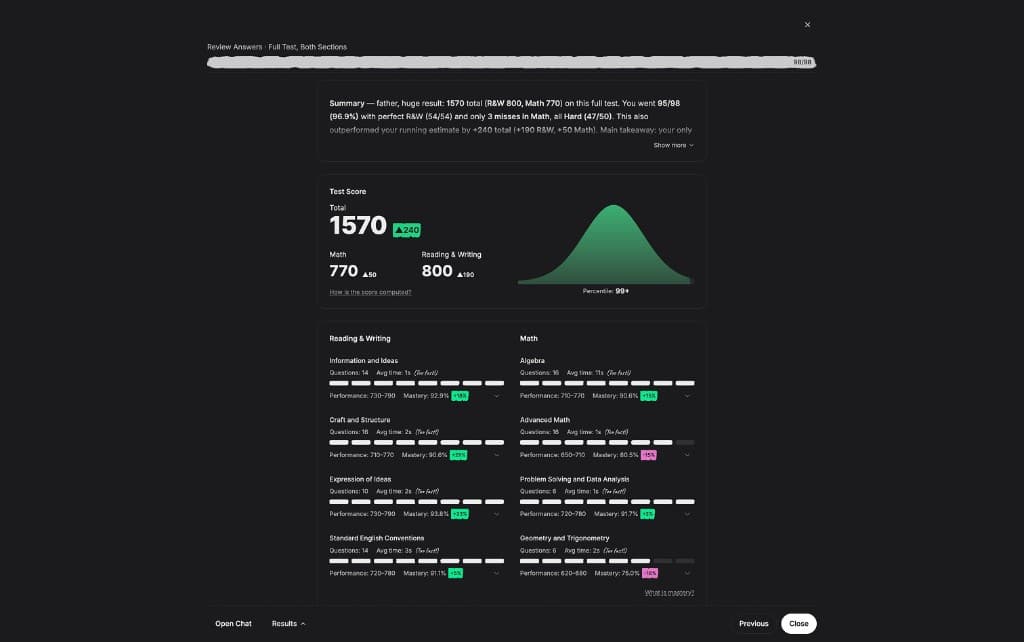
“I really didn't have any days where I didn't want to study. The feeling of progression that's given from the analytics page is very motivating.”
Once you understand the result, continue with the next task in your study plan priorities, which are also included in your analytics at the bottom to make it easy to find and continue with the next task.
6. Unlock your score prediction
Your first diagnostic starts the picture. Your score prediction becomes available after:
- One full-length Aniko practice test
- Eight Study Session or Review Lab tasks from your plan
This work gives Aniko enough evidence to understand both your full-test performance and the way your mastery changes through focused practice.
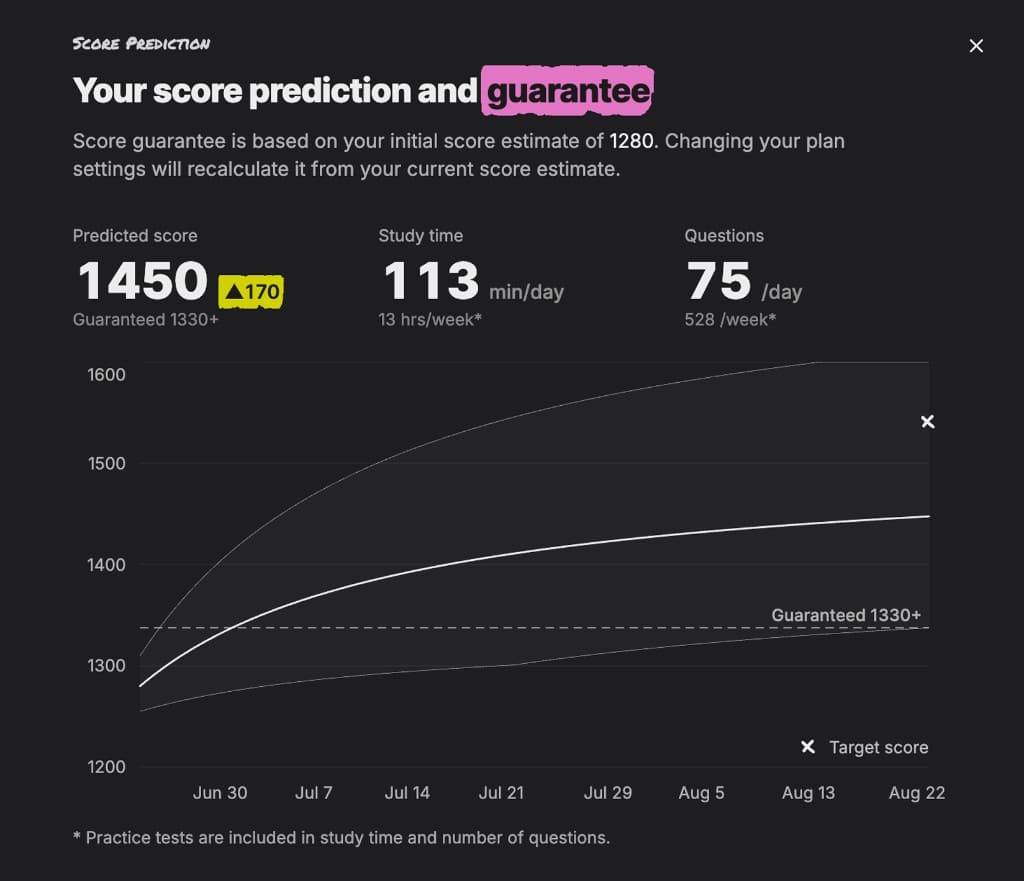
Once unlocked, the dashboard shows three different scores:
- Current score estimate: the score Aniko expects you to get if you took the SAT now
- Predicted score: where Aniko expects you to reach by your SAT date if you follow the plan
- Guaranteed score: the minimum score Aniko expects you to get by your SAT date
Your current estimate changes in real time after every Study Session and practice test, so you always see your progress. It moves as your demonstrated mastery changes. That is what makes each increase meaningful. Your predicted and guaranteed scores are anchored to your study plan. They change only when you change plan settings such as study intensity, SAT date, domain focus, or practice-test frequency.
“When the platform estimated I was at a 1530, I went out and got a 1540.”
For students with a Premium subscription, the prediction becomes a guarantee. To qualify:
- Start your subscription at least 14 days before your SAT
- Complete the diagnostic and unlock your score prediction
- Complete at least 90% of your study plan before test day
If your official SAT score is below the score Aniko guaranteed, you can choose a refund of your subscription payments from the three months before the test or 12 months of Aniko free. Read legal terms.
More than 4,624+ students have shared their official SAT scores in Aniko's analytics. Those real outcomes help validate the study system and give us the confidence to back the study plan with a score guarantee.
7. Take one full practice test each week
Study Sessions build individual skills. Full-length practice tests teach you to combine them under real SAT conditions.
We recommend taking one full practice test each week. Choose a quiet place, remove distractions, use only the tools available on the digital SAT, and complete the sections with the official timing. Set aside about three hours for the test, the break, and an initial review.
In addition to your weekly Aniko tests, take at least one full-length Bluebook practice test before test day. Bluebook is College Board's official testing app and the same software you will use on the SAT. Use it to get comfortable with the navigation, timing, and built-in tools before the real test.
The goal is not only to collect a score. A full test reveals:
- Whether your skills hold up across 98 questions
- How your focus changes over two hours
- Which strategies remain reliable under time pressure
- Where you lose time
- Whether recent mastery gains transfer to a complete SAT
Review the test as carefully as you took it. Read every missed explanation, inspect the timing chart, and turn the most important mistakes into Similar Questions or a Review Lab.
If you need to stop, Aniko saves your progress so you can resume later. For your regular weekly test, completing it in one realistic sitting gives you the best preparation for test day.
Use short and half practice tests for focused timing work between full tests. They let you practice pacing without adding another complete SAT to the week. For deeper help with confidence and test conditions, read our guide on how to overcome SAT test anxiety.
8. Make consistency easier
The best study system is the one you keep using. Aniko makes progress visible and gives each day a clear finish line.
Use the motivation tools that work for you:
- Protect your streak. Complete at least one task on each scheduled study day.
- Raise your level. Your level grows with the total number of questions you answer.
- Earn achievements. Master domains, finish practice tests, improve your score, and reach study milestones.
- Follow friends. See their progress, encourage them, and study alongside people working toward the same goal.
- Check the leaderboard. Friendly competition gives the week energy and makes effort visible.
- Join a challenge. Challenges add daily targets, leagues, prizes, and a shared deadline.
- Use Discord for accountability. Share progress, ask for help, and meet students who are doing the same work.
The SAT Lock-In Challenge showed how powerful that combination can be. Students answered more than 400,000 questions in 18 days and studied for roughly 94 minutes per study day. Students who consistently followed their personalized plan raised their predicted scores by 130 points on average during the challenge.
“Don't wait for motivation. Most people think successful students are motivated every day. They're not. The difference is that they study even when they don't feel like it. Focus on consistency first. A small amount of work every day beats huge study sessions that only happen once in a while.”
Aniko gives that consistency a structure. You always know what to do, your progress keeps moving, and showing up becomes a habit instead of a daily negotiation.
For a deeper look at streaks, levels, achievements, and leaderboards, read how Aniko turns SAT prep into a game.


Join the Aniko Discord community to meet other students, share your progress, and hear about the next challenge.
9. Avoid the habits that waste progress
Aniko removes most of the guesswork from SAT prep, but the quality of your attention still matters.
Do not replace the plan with random practice
Extra practice can help, but your plan should come first. It connects each task to your weaknesses, goal, and test date.
Do not skip the review
Answering 50 questions without understanding the mistakes is less valuable than answering 20 and correcting every weak approach.
Do not read explanations passively
Pause before moving on. Restate the strategy in your own words and prove it with a Similar Question.
Do not chase speed before accuracy
Build a reliable solving process first. Timing improves much faster when you are no longer hesitating between approaches.
Do not take practice tests only for the score
The score is one result. The error patterns, timing data, and mastery changes tell you how to earn the next increase.
Do not hide from weak areas
The topics you avoid are often the ones holding back your score. Let Aniko target them directly, then stay with the work until they become strengths.
10. What an effective week can look like
Your exact week should come from Aniko. The plan adapts to your schedule, current mastery, recent mistakes, and SAT date. This example shows how the pieces can work together:
Monday: Begin with the plan
Complete the recommended Study Session. Read the Game Plan, focus on accuracy, and review every mistake.
Tuesday: Reinforce the weak skill
Complete the next planned task. Use Similar Questions for anything you missed or solved with uncertainty.
Wednesday: Revisit old mistakes
Complete a Review Lab using errors, bookmarks, or both. Save any question that teaches an approach worth returning to.
Thursday: Add focused timing
Complete your planned session, then use a short practice test or timed drill on a skill you already understand well.
Friday: Strengthen the remaining gap
Follow Study plan priorities. Keep the session lighter if you need energy for the full test.
Saturday: Take a full-length practice test
Recreate real SAT conditions. Afterward, inspect the score, timing, error patterns, and mastery changes.
Sunday: Turn the test into next week's progress
Review the most important mistakes, create Similar Questions or a Review Lab, and let Aniko adapt the next tasks.
Some students will study fewer days. Others will complete more questions or place the full test on Sunday. The structure remains the same: targeted practice, deliberate review, weekly testing, and an adaptive next step.
Your next task is the right place to start
You do not need to design the perfect SAT schedule yourself. You need an honest diagnostic, a goal you care about, and the discipline to complete the next useful task.
Let Aniko decide what deserves your attention. Read the Game Plan. Solve carefully. Treat mistakes as valuable data. Apply the better approach again. Review your analytics. Take the weekly test. Then do it again with a plan that has already adapted to everything you learned.
That is how progress compounds. The questions stop feeling unfamiliar. Weaknesses become strengths. Your score moves because your ability has changed.
Start your personalized SAT study plan with Aniko, or explore the free SAT question bank and begin with the skill that needs your attention today.