An 800 is a clean section. Near the top, each miss costs about 10 points.
Here’s the good news. 700+ students lose their last points in the same four places. Fix those, and an 800 stops being luck. Sam went from 790 to 800 in three weeks by practicing only what he still missed.
Where 700+ students lose their last Math points
- Hard Geometry and data1 in 3of the hard ones missed
- The condition you skip59%counted a hole as an x-intercept
- Hard grid-ins1 in 3missed, with no choices to check
- The easy question you rush1 in 18easy questions missed
At 770+, plan for zero misses. Take a practice test on Aniko: your Math score breaks down by skill, so you see which of the four places your last one or two misses came from. Start there. From 700 to the 760s, start with the first place: hard Geometry and data. Below 700? Start with the 600s row in SAT Math Tips.
An 800 Means Zero Misses
How many questions can you miss and still get an 800? Plan for none. On Aniko’s practice tests, one miss near the top makes a 790.
On the real SAT, one miss sometimes still gets an 800. That’s partly because each module has 2 questions that don’t count, and nobody knows which ones, and partly because the SAT weighs questions by difficulty. So you can’t plan on it. How the SAT is scored explains why, and the SAT Score Calculator lets you try your own numbers.
One 800 can be a good day. An 800 you hit again and again is skill. So aim for practice tests you finish clean, with time left, again and again. That’s the 800 that holds on test day.
1. Hard Geometry and Data Questions
At 700+, easy and medium questions rarely cost you. Hard ones do: 700+ students on Aniko miss about 1 in 4, and those misses aren’t spread evenly:
Share of hard questions 700+ students miss
By domain
- Geometry and Trigonometry34%
- Problem-Solving and Data Analysis32%
- Advanced Math21%
- Algebra20%
The skills that miss most
- Probability34%
- Percentages34%
Hard Geometry and data questions catch 700+ students most.
The gap usually isn’t a formula you forgot. It’s a step the formula won’t take for you. Try two.
Try one: the longest segment
A stage manager recorded the lengths, in minutes, of 10 rehearsal segments. Each segment length was a distinct integer. The shortest segment was 2 minutes. The mean segment length was 8 minutes, and the median segment length was 7.5 minutes.
Which choice is the smallest possible length, in minutes, of the longest rehearsal segment?
Worked solution
The mean fixes the total: minutes. The median fixes the middle pair: the 5th and 6th lengths add to 15. Keep them as close as they can be, 7 and 8: a wider pair, like 6 and 9, pushes the four longest higher.
To keep the longest segment short, make every other length as long as the rules allow. Below the median, that's 2, 4, 5, 6 and 7. With the 8, that's 32 minutes, which leaves 48 for the four longest.
Four different integers above 8 that add to 48 can't all be 13 or less: . So the longest is at least 14, and 10, 11, 13, 14 works.
To make one value as small as it can be, make every other value as large as the rules allow.
Try one: the given region
A point is selected at random from the square region defined by and .
Given that the selected point satisfies , which choice is the probability that it also satisfies ?
Worked solution
"Given that" makes the quarter circle the whole. Its area is .
Inside it, is the triangle with corners , and , with area . The whole triangle sits inside the quarter circle.
So the probability is .
Dividing by the square's area, 16, gives , and the quarter circle's share of the square is . Both answer a question it didn't ask.
To close the gap, practice hard questions in the skills you miss most. These sets are free:
- 50 Super-Hard Problem-Solving and Data Analysis Questions
- 25 Super-Hard Geometry and Trigonometry Questions
- The Math question bank, one skill at a time: Area and Volume, Probability, Center and Spread
The formula traps for these skills are in SAT Math Tips.

2. The Condition You Skip
Should you learn Desmos for an 800? Yes. Desmos is the fastest route on most questions (the Desmos moves). But the hardest ones hinge on one condition: a hole, an integer, a “must”. Desmos only sees that condition if you ask. Try this one.
Try one: the hole
In the equation above, and are distinct positive constants. When the equation is graphed in the -plane, how many distinct -intercepts does the graph have?
Worked solution
Cancel what you can: the equation simplifies to . That looks like two intercepts, at and .
But the original equation divides by , so and aren't allowed at all. The graph has a hole at , not an intercept.
That leaves one -intercept, at .
In Desmos: the graph hides the hole. Ask it.
- 1Open the calculator. The function is in as
f(x)=, with sliders at and . On the test, type it the same way, withf(x)=, so you can ask about single values. - 2Look at the graph. It crosses the x-axis at and at , with no gap. That’s where the answer 2 comes from.
- 3Ask Desmos about each crossing. Type
f(b)and you get undefined. Typef(a)and you get 0. So is a hole, and is the only intercept. - 4Drag the sliders. Any two different positive values give the same answer: 1.
Learn it in Keep the excluded inputs when you simplify (Desmos) and Rewrite rational expressions and preserve restrictions (by hand).
The next one hides its condition in the first sentence.
Try one: the integer y
The variables and are integers. If satisfies all of the following inequalities,
Which choice is the greatest possible value of ?
Worked solution
(1) and (3) together give , so , and 14 looks fine.
But has to be an integer too. At , (1) says and (3) says . No integer fits between them.
At : , and , so , 20 or 21 all work. The greatest is 13.
In Desmos: zoom in where the region ends
- 1Graph all three as one region. Type the first inequality, then the other two in curly braces:
y>1.5x-1{y<=2x-5}{y<-x+35}. Desmos shades only where all three are true. - 2Add the line x = 14. Type
x=14. The region reaches past it, so 14 looks fine. - 3Zoom in. The line crosses the region only between and , and neither edge counts. So no integer works at . At , 19, 20 and 21 all work.
Learn it in Inequalities and shaded overlap.
“Must be true” is where Desmos stops. It graphs one case, not every case. One question in our bank factors into integer factors and asks what must be true of . More students picked “b is odd” than the right answer. One case that breaks a choice rules it out:
- is , so can be 22. Not odd, and not a multiple of 8.
- is , so can be 29. Not even.
That leaves the right answer: “b is not a multiple of 4”.
Here are the conditions behind the hardest questions on Aniko. One habit catches all of them: before you answer, reread the condition in the original question.
The conditions that decide the hardest questions
| The condition | What beats it | Lesson |
|---|---|---|
| A factor that cancels leaves a hole, not an intercept. | Evaluate the original at that x. Undefined means a hole. | Restrictions, piecewise functions, and rational expressions |
| “x and y are integers”: both of them, not just the one you solve for. | At your x, find an integer y that fits every inequality. | Graph and model two-variable inequalities |
| “Must be true” means in every case. | Look for one case that breaks each choice. A choice that fails once is out. | Meet every condition |
| “Given that” a point is in a region, that region is the whole. | Divide by the given region’s area, not the square’s. | Use two-way tables and conditional probability |
Practice the check in Meet every condition.
3. Hard Grid-Ins: No Choices to Catch You
On a hard question, a grid-in raises the miss rate: 1 in 3, against fewer than 1 in 4 on multiple choice. The gap is widest in Geometry and data:
Share of hard questions 700+ students miss, multiple choice against grid-in
Geometry and Trigonometry
Multiple choice31%Grid-in47%Problem-Solving and Data Analysis
Multiple choice30%Grid-in44%Advanced Math
Multiple choice20%Grid-in30%Algebra
Multiple choice20%Grid-in25%
With no choices, nothing tells you you’re wrong. Two checks do that job for you:
- Estimate first. Guess a rough size before you solve. If your answer is far from it, your setup slipped.
- Check in the original. Put your answer back into the question’s first fact, not into your last line.
Try them on a geometry grid-in. An altitude to the hypotenuse makes three similar right triangles, and one ratio works in all of them (Use similarity inside right triangles).
Try one: the altitude
In right triangle , is a right angle. The altitude from to the hypotenuse has length . If , what is the length of side ?
Worked solution
Draw the altitude. It makes a small right triangle with angle , the altitude opposite and as its hypotenuse. So , and .
Carry the ratio to the big triangle. makes it a 3-4-5 triangle, so . In triangle , , so .
Check in the original: , and the altitude is . It matches.
Students who entered 15 found and stopped one step short. Estimating first catches it: is the hypotenuse, so it has to be longer than 15. Before you enter a grid-in, reread what it asks. Then check the grid-in entry rules.
4. The Easy Question You Rush
Even at 700+, students miss about 1 easy question in 18. Near the top, that miss costs as much as a hard one.
So check each answer a different way from how you solved it. Plug it back into the question, or graph it in Desmos. SAT Math Tips has the checks for each question type.
The last piece is time. Finish Module 2 with about 5 minutes left, and use them to recheck the questions you marked and every grid-in. Running out of time? Get faster on hard questions: work through the 200 Super-Hard SAT Math Questions at about 2 minutes each.
Miu did this. She finished her next SAT with time left to recheck every answer, and got her 800.
The Module 2 time plan has the full routine.
From 790 to 800: Sam’s Three Weeks
Sam scored 790 in Math on the August SAT. Three weeks later, on September 12, he scored 800, and a 1600 overall.
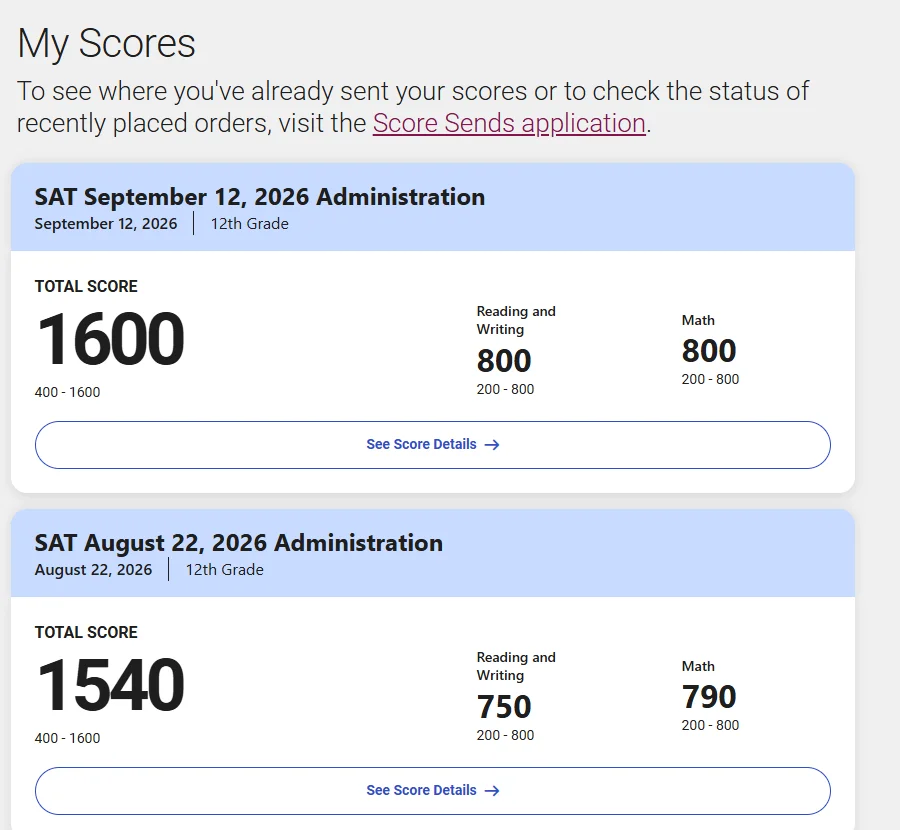
He’d been doing 110 questions a day in the Lock-In Challenge. With school exams coming, he couldn’t keep that up, so he narrowed down:
I left out the topics I was getting right and focused only on the topics I was struggling with.
He added Aniko’s new super-hard questions and College Board’s new practice questions.
That’s the whole method: find the skills that still cost you points, and practice there. Sam’s story has the rest.
It works beyond Sam. Near the top, a retake score more often slips than climbs. Students at 700+ who kept practicing Math on Aniko between two SATs went the other way: 70% raised their Math score.
Students at 700+ in Math: how often their next SAT Math went up
300+ Math questions on Aniko between the two SATs
70% went upTypical change: +20 points
No Math practice on Aniko between them
31% went upTypical change: −10 points
Aniko does the narrowing for you. It tracks how well you know each Math skill the SAT tests, so it sees which ones still cost you points. When you keep missing the same idea, a lesson on it comes first, then a session to put it to work.