From geometry to coordinates to circle regression

Lesson progressPractice problems 0/4
Difficulty
GOAT Mode
Estimated time
40 minutes
Techniques
Circle RegressionCoordinate GeometryExactnessMethod Choice

What you’ll learn

  1. Recognize when circle regression is worth considering.
  2. Convert geometric information into exact coordinate points.
  3. Recover a circle with a custom regression that is linear in its fitted parameters.
  4. Identify the center, radius, squared radius, equation, or coefficient requested.
  5. Verify an exact candidate against every point and condition.
  6. Choose a shorter geometry method when regression adds no value.

Why this matters on the SAT

Recover a circle from three exact points

The SAT tests circle equations, coordinate geometry, distance, and circle theorems. It will not ask you to perform circle regression by name. Regression is a shortcut when exact geometric information determines one circle but perpendicular-bisector algebra would take too long.

SAT example

Rectangle ABCDABCD has side lengths AB=16AB=16 and BC=4BC=4. Point EE is the midpoint of CD\overline{CD}. A circle passes through AA, BB, and EE. What is the radius of the circle?

Fast Desmos solution

Place the exact points at A=(8,0)A=(-8,0), B=(8,0)B=(8,0), and E=(0,4)E=(0,4). Enter them in a table and fit x_1^2+y_1^2~ux_1+vy_1+w. Desmos displays the candidate values u=0u=0, v=12v=-12, and w=64w=64, so the candidate center is (0,6)(0,-6) and r2=64+36=100r^2=64+36=100. Verify every point: AA and BB each give 82+62=1008^2+6^2=100, and EE gives 02+102=1000^2+10^2=100. The radius is 10\boxed{10}.

Try it yourself:

Change EE's yy-coordinate from 44 to 66, watch the fitted circle change, then reset the example.

The order matters: create exact coordinates, recover a candidate circle, convert the output into the requested form, and verify the exact result. Regression cannot supply a missing condition, replace a theorem, or prove that a rounded decimal is exact.

Calculator loads as you approach
Exact geometry becomes three points, and the regression recovers the circle.

When is circle regression worth it?

Start by asking whether the geometry gives enough exact information and whether regression is genuinely shorter.

Use circle regression when…

  • you know three distinct, noncollinear points on one circle;
  • the center is not obvious from a diameter or symmetry; and
  • awkward coordinates or exact answer choices make a fitted model faster.

Use a shorter geometry method when…

  • the center and one point are known;
  • a diameter or right inscribed angle reveals the center;
  • symmetry, midpoint, or distance gives the result directly; or
  • the given circle equation can be interpreted or completed quickly.

Two arbitrary points do not determine one circle. Three collinear points do not determine a circle either.

Check your understanding:

A circle has diameter endpoints (4,2)(-4,2) and (6,8)(6,8). Should you begin with circle regression or with midpoint and distance? Explain your choice.

1. Turn the geometry into exact points

Choose coordinates that make the given geometry simple. Use symmetry, midpoint, the Pythagorean theorem, or a circle theorem before opening Desmos.

  • Put a horizontal segment of length ss at (s2,0)\left(-\frac{s}{2},0\right) and (s2,0)\left(\frac{s}{2},0\right).
  • Put a symmetric point on the yy-axis.
  • Derive heights and distances exactly instead of measuring the diagram.
  • Confirm that three boundary points are distinct and noncollinear.
Check your understanding:

A horizontal base has length 1212 and midpoint at the origin. Name its two endpoint coordinates before continuing.

Common mistake:

Estimating a point from a diagram or rounding a derived coordinate before entering it. The regression result can only be as accurate as the points you supply.

2. Fit a circle with linear parameters

The familiar center-radius equation is

(xh)2+(yk)2=r2.(x-h)^2+(y-k)^2=r^2.

Fitting hh and kk directly makes the regression nonlinear. Expand it into a model that is linear in the fitted parameters:

x2+y2=2hx+2ky+(r2h2k2).x^2+y^2=2hx+2ky+\left(r^2-h^2-k^2\right).

Direct center-radius regression can work too. This lesson uses the expanded form because its fitted coefficients map consistently to the center, squared radius, and standard-form equation.

Enter the point coordinates in x_1 and y_1, then type:

x_1^2+y_1^2~ux_1+vy_1+w

Convert the output with

h=u2,k=v2,r2=w+h2+k2.h=\frac{u}{2},\qquad k=\frac{v}{2},\qquad r^2=w+h^2+k^2.

In the calculator, q is a short helper name for r2r^2.

For standard form,

x2+y2+Dx+Ey+F=0,x^2+y^2+Dx+Ey+F=0,

move every fitted term to the left:

x2+y2uxvyw=0.x^2+y^2-ux-vy-w=0.

Therefore, D=uD=-u, E=vE=-v, and F=wF=-w.

For three exact noncollinear points, this model recovers the unique candidate circle apart from numerical display precision. Noisy best-fit circle modeling is outside this lesson.

Try it yourself:

Change one table value, watch hh, kk, qq, and the circle update together, then reset the example.

Check your understanding:

A circle regression returns u=6u=6, v=4v=4, and w=8w=-8. What are the center and r2r^2?

Calculator loads as you approach
The table determines the circle; h and k are its center coordinates, and q is its squared radius.

3. Build the circle, then answer the question

This example combines the full workflow. Regression is useful here, but symmetry or exact algebra can still provide a shorter check.

Worked example

An isosceles triangle is inscribed in a circle.

Its base has length 1212, is horizontal, and has midpoint at the origin.

Its two equal sides each have length 1010.

What is the radius of the circle?

Step 1

Create exact coordinates

Check your understanding:

The base endpoints are (6,0)(-6,0) and (6,0)(6,0), and each equal side has length 1010. If the third vertex is on the positive yy-axis, what are its coordinates?

Place the vertices at

(6,0),(6,0),(0,8).(-6,0),\qquad (6,0),\qquad (0,8).

The height 88 comes from 10262\sqrt{10^2-6^2}, not from measuring the diagram.

Calculator loads as you approach
The exact triangle vertices become the three points used for regression.

Step 2

Recover the center and squared radius

Enter x_1^2+y_1^2~ux_1+vy_1+w. Desmos displays the candidate values

u=0,v=3.5=72,w=36.u=0,\qquad v=3.5=\frac72,\qquad w=36.

Therefore,

h=0,k=74,h=0,\qquad k=\frac74,

and

r2=36+(74)2=62516.r^2=36+\left(\frac74\right)^2=\frac{625}{16}.
Calculator loads as you approach
The regression recovers the circle through all three exact vertices.

Step 3

Answer the requested quantity

The question asks for the radius, not r2r^2. Take the positive square root:

r=62516=254.r=\sqrt{\frac{625}{16}}=\frac{25}{4}.

Verify all three vertices with the exact center (0,74)\left(0,\frac74\right):

(6)2+(74)2=62516,(-6)^2+\left(-\frac74\right)^2=\frac{625}{16},
62+(74)2=62516,6^2+\left(-\frac74\right)^2=\frac{625}{16},

and

(874)2=62516.\left(8-\frac74\right)^2=\frac{625}{16}.

Therefore, the radius is

254.\boxed{\frac{25}{4}}.
Common mistake:

Reporting 62516\frac{625}{16} when the question asks for the radius. That value is r2r^2.

Finish the solution

The points and regression are already entered. Use the fitted parameters to reconstruct the exact circle equation.

Convert the regression into a circle equation

Finish the solution

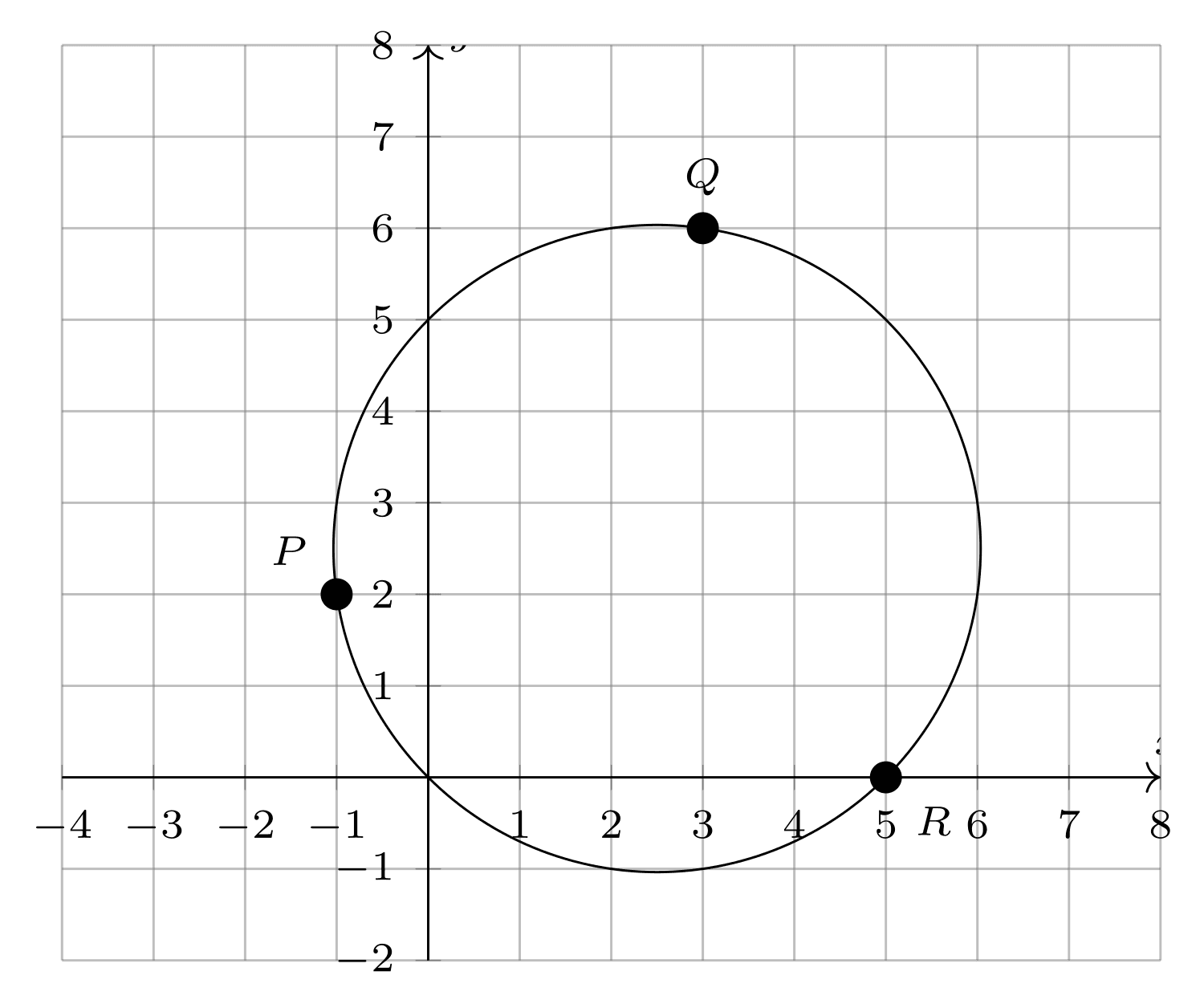
In the coordinate plane, circle CC passes through points PP, QQ, and RR shown in the figure.

Coordinate plane showing circle C through P at negative 1 comma 2, Q at 3 comma 6, and R at 5 comma 0.
Circle C passes through P, Q, and R.

Which equation represents circle CC?

First steps

  1. Enter P=(1,2)P=(-1,2), Q=(3,6)Q=(3,6), and R=(5,0)R=(5,0) in a table.
  2. Enter x_1^2+y_1^2~ux_1+vy_1+w.
  3. Desmos displays the candidate values u=5u=5, v=5v=5, and w=0w=0.

Finish it

Answer choices
Calculator loads as you approach
The points and regression are ready. Convert u, v, and w to the exact equation.

Practice problems

SAT practice problems

Begin each problem from a clean calculator. Choose the shortest valid method, then verify the exact quantity the question requests.

Recover an exact circle from three points

Practice problem

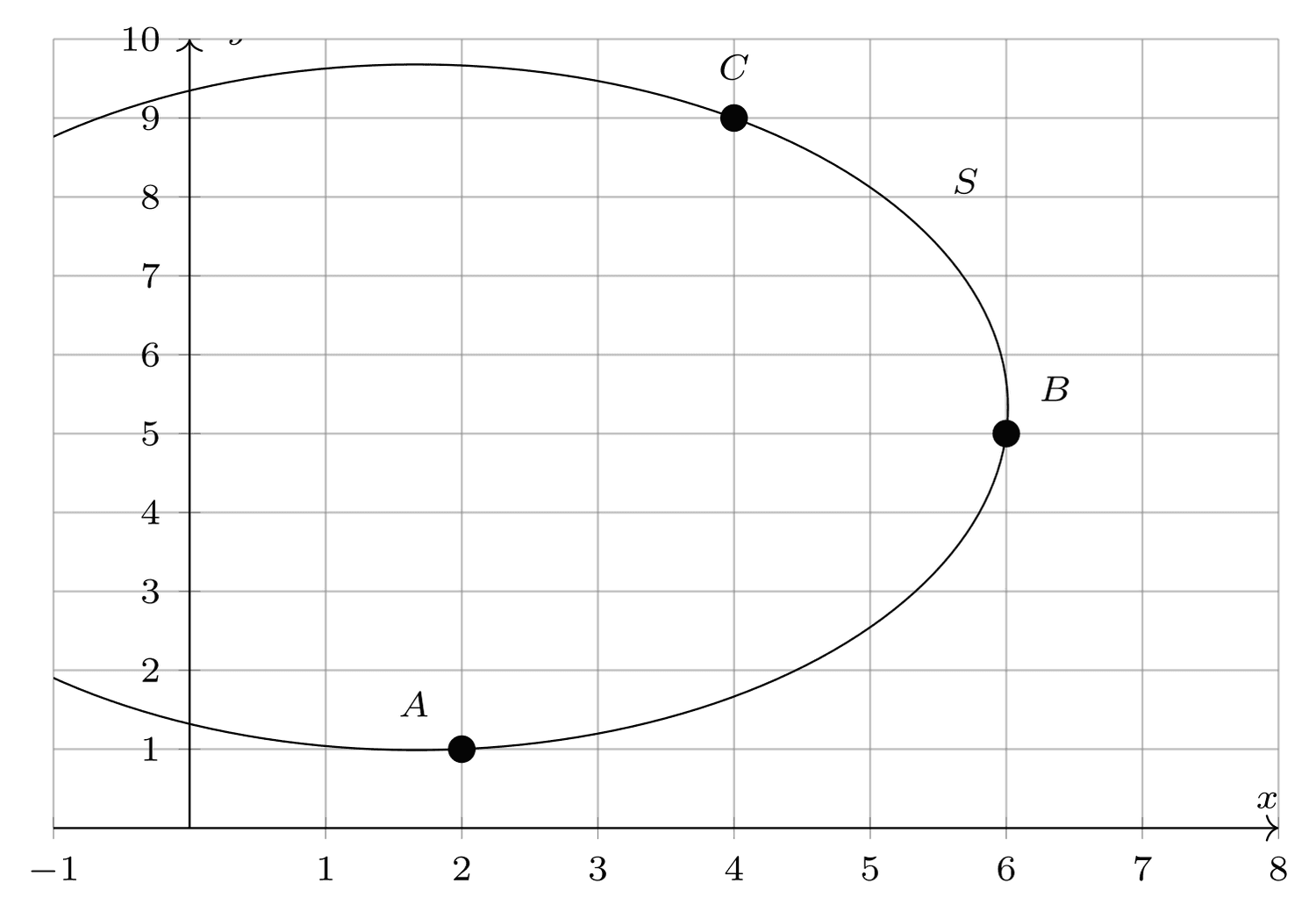
In the coordinate plane shown, buoys AA, BB, and CC mark three locations on circle SS, the boundary of a circular marine sanctuary.

Coordinate plane showing circle S through A at 2 comma 1, B at 6 comma 5, and C at 4 comma 9.
The three buoy locations lie on circle S.

Which choice gives an equation of the circle that forms the boundary?

Answer choices
Calculator loads as you approach
Enter the three exact points, fit the circle, and match the output to an exact choice.

Notice the diameter before using regression

Practice problem

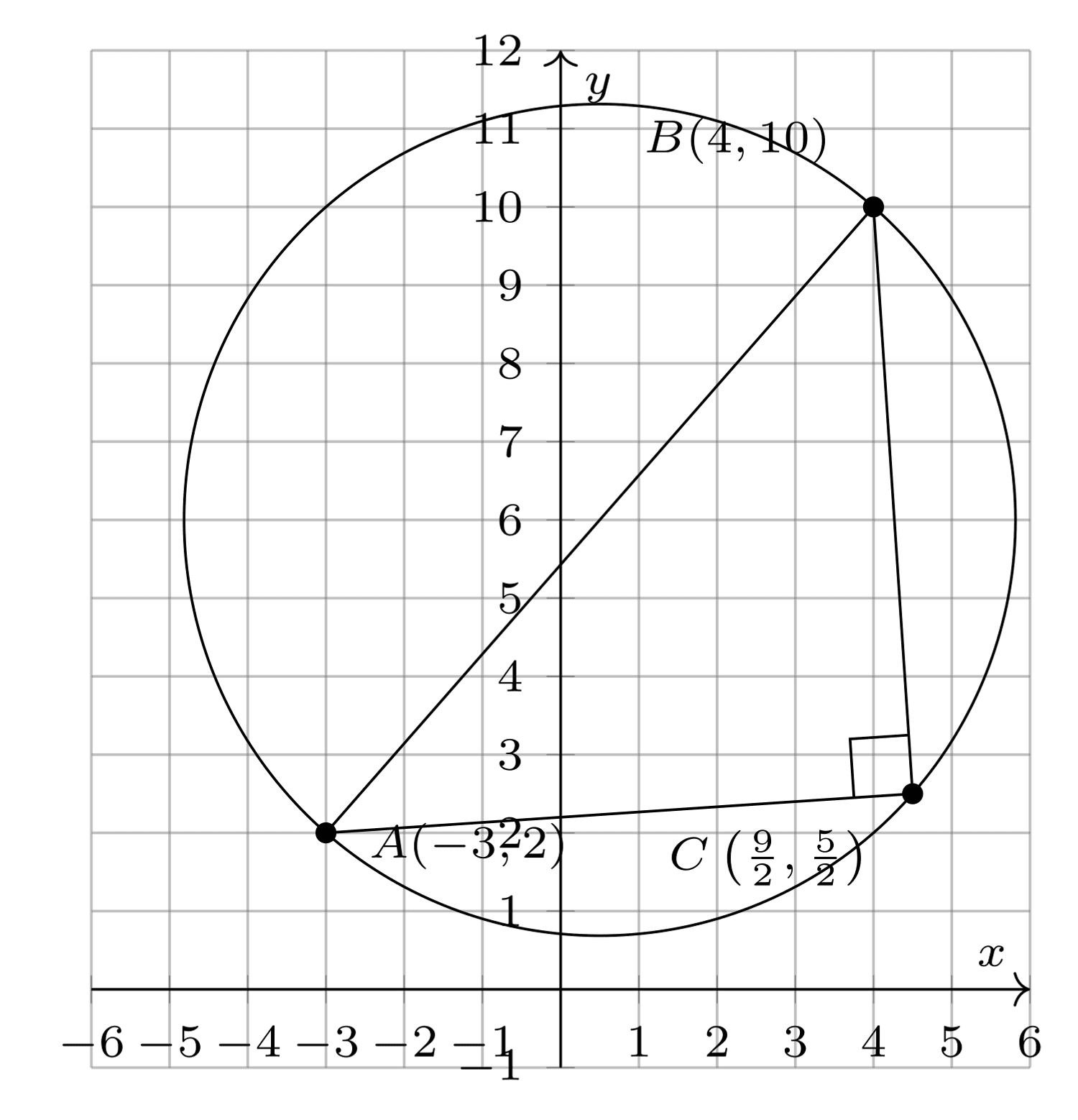
Triangle ABCABC is inscribed in a circle. The coordinates are labeled, and ACB\angle ACB is a right angle.

Coordinate plane showing an inscribed triangle with A at negative 3 comma 2, B at 4 comma 10, C at nine halves comma five halves, and a right angle at C.
The right angle at C identifies a diameter.

Which equation of the form

x2+y2+Dx+Ey+F=0x^2+y^2+Dx+Ey+F=0

represents the circle?

Answer choices
Calculator loads as you approach
Choose the shortest method before typing, then use Desmos to verify the equation.

Challenge: include a center constraint

Practice problem

A circle in the xyxy-plane passes through (4,0)(4,0) and (0,6)(0,6) and has its center on the line

y=x+10.y=-x+10.

An equation of the circle can be written as

x2+y2+ax+by+c=0,x^2+y^2+ax+by+c=0,

where aa, bb, and cc are constants. What is the value of cc?

Calculator loads as you approach
Use the center-line condition inside the regression, then convert the output to c.

Finish the lesson

4 practice examples left

Finish the remaining questions correctly to complete this lesson.

Quick recap

  • Use geometry first to create exact points and identify shortcuts.
  • Three distinct, noncollinear points determine one circle.
  • Fit x_1^2+y_1^2~u x_1+v y_1+w for a model linear in its parameters.
  • Convert with h=u2h=\frac{u}{2}, k=v2k=\frac{v}{2}, and r2=w+h2+k2r^2=w+h^2+k^2.
  • Verify the exact circle against every point and condition.
  • Reread the prompt before submitting a radius, equation, or coefficient.
  • Use midpoint, distance, symmetry, or a circle theorem when it is shorter.

Next lesson

When not to use Desmos

Sharpen method choice and avoid calculator setups that cost more time than they save.

Start next lesson

Free Practice

Free question bank practice problems

Circle Regression in Desmos for SAT Geometry | aniko.ai