Exactness, rounding, and output verification

Lesson progressPractice problems 0/5
Difficulty
GOAT Mode
Estimated time
50 minutes
Techniques
ExactnessRoundingOutput VerificationAnswer Entry

What you’ll learn

  1. Distinguish exact calculator results from numerical approximations.
  2. Choose between an exact value, explicit rounding, and a valid student response.
  3. Preserve full precision until the final step.
  4. Recover exact fractions and radical choices from numerical output.
  5. Choose between short exact algebra, one Desmos expression, and a table.
  6. Verify the requested quantity, units, restrictions, and response form.

Why this matters on the SAT

Turn calculator output into the answer the SAT will score

Desmos may show a decimal, a point, a regression parameter, or a calculation. The SAT may ask for an exact fraction, an exact answer choice, a rounded measurement, a percent without the percent sign, or a quantity built from several displayed values. The number on the calculator is evidence, not automatically the final answer.

SAT example

In a laboratory, xx and yy are positive amounts that satisfy

x+y=12,x2y+xy2=135.\begin{aligned} x+y&=12,\\ x^2y+xy^2&=135. \end{aligned}

If x>yx>y, which choice gives the value of xx?

A. 6+31126+\frac{3\sqrt{11}}{2}

B. 631126-\frac{3\sqrt{11}}{2}

C. 6+1126+\frac{\sqrt{11}}{2}

D. 454\frac{45}{4}

The intersection with x>yx>y is approximately (10.975,1.025)(10.975,1.025). Choice A has the matching numerical value, so it is the exact candidate.

Try it yourself:

Select both intersections, identify the one satisfying x>yx>y, and compare its xx-coordinate with choices A and B. Then reset the example.

If x=6+3112x=6+\frac{3\sqrt{11}}{2} and y=63112y=6-\frac{3\sqrt{11}}{2}, then x+y=12x+y=12 and

xy=36(3112)2=454.xy=36-\left(\frac{3\sqrt{11}}{2}\right)^2=\frac{45}{4}.

Therefore,

x2y+xy2=xy(x+y)=454(12)=135.x^2y+xy^2=xy(x+y)=\frac{45}{4}(12)=135.

The answer is A. Desmos found the candidate, and exact substitution confirmed it.

Calculator loads as you approach
The graph locates the solution with x greater than y, while the choices supply exact forms.

When should you use algebra, Desmos, or a table?

Choose the least setup that preserves exactness.

Use short exact algebra when…

  • one or two steps produce the exact requested value; or
  • the equations, geometry, or factorization already reveal exact form.

Use Desmos when…

  • One expression or graph locates a difficult candidate, compares exact choices, or handles one long calculation;
  • A table keeps paired rows aligned for regression or model checking; or
  • A table applies the same rule to several candidates or derived rows.

Best default: use algebra for a short exact route, one Desmos expression for one calculator task, and a table for repeated rows. A table organizes numerical work; it does not prove that a displayed decimal is exact.

Check your understanding:

Choose the best setup: (1) evaluate f(6)f(6), (2) test four candidate inputs in the same function, and (3) solve 3x=23x=2 exactly.

1. Know what Desmos actually gave you

An exact value keeps the complete mathematical value, such as 136\frac{13}{6}. An approximation is a nearby decimal, such as 2.1672.167. A longer decimal is still approximate if it came from a graph point or regression.

The graph shows the intersection of y=2x+1y=2x+1 and y=x+3y=-x+3 numerically. Exact algebra gives

2x+1=x+3,2x+1=-x+3,

so x=23x=\frac23 and y=73y=\frac73. The graph label was a locator; the equations supplied the exact point.

Check your understanding:

A regression displays m=0.333333m=0.333333. An answer choice gives m=13m=\frac13. Does the display prove the exact value? What should you do next?

Common mistake:

Copying every displayed digit and treating it as exact. Graph points and regression parameters are numerical approximations.

Calculator loads as you approach
The graph displays a numerical point. The exact intersection is (2/3, 7/3).

2. Decide which kind of answer the prompt requires

Before changing the calculator output, reread the final sentence. Put the answer into one of three categories.

Exact answer

Keep or recover exact fractions, radicals, expressions involving π\pi, coefficients, and exact answer choices. Use the decimal to locate the candidate, then verify it.

Explicitly rounded answer

If the prompt says nearest whole number, tenth, or hundredth, keep full precision and round once at the end. For example, 0.6560.656\ldots rounds to 0.660.66 at the nearest hundredth.

Student-produced response

With no rounding instruction, prefer an exact fraction that fits. Positive responses allow up to 5 characters and negative responses up to 6, including signs, decimal points, and fraction bars.

To truncate means to stop without changing the last retained digit. For 23\frac23, valid entries include 2/3; .6666 or 0.666 by truncation; and .6667 or 0.667 by rounding. Omitting the leading zero leaves room for four decimal digits; including it leaves room for three. Do not enter a mixed number, percent sign, comma, or dollar sign. The complete Bluebook answer-entry workflow is covered in Lesson 30.

Check your understanding:

Desmos gives 1273=0.16438\frac{12}{73}=0.16438\ldots, and the prompt gives no rounding instruction. Which response is simplest and safest?

Common mistake:

Applying the response-field character rule when the prompt gives a specific rounding instruction. The prompt controls.

3. Recover an exact value without guessing

Route 1: Keep exact inputs exact. Enter fractions as fractions and radicals as radicals. For a direct calculation, Desmos can convert 36/219 to the simplified fraction 1273\frac{12}{73}.

Try it yourself:

Toggle the first result between decimal and fraction form. Then change 36/219 to 45/252 and confirm that Desmos simplifies it to 528\frac{5}{28}. Reset when you finish.

Route 2: Match an approximate result to exact choices. If a graph gives x7.571x\approx7.571 and a choice gives 5377.571\frac{53}{7}\approx7.571, treat the fraction as the exact candidate and verify it.

Route 3: Reconstruct from the mathematics. Use exact equations, geometry, or model structure. Solve lines algebraically or test a circle radius in the original equation. For regression, verify every point only when the prompt promises an exact fit. For a genuine best fit, compare the candidate with the fitted numerical parameter.

Check your understanding:

A graph shows x12.702x\approx12.702, and the choices include 19+412\frac{19+\sqrt{41}}{2}. What is the fastest reliable next step?

Common mistake:

Converting a rounded graph label to a fraction and assuming that fraction is the original exact answer.

Calculator loads as you approach
Both lines have the same value. Use the fraction conversion icon to display the simplified exact fraction.

4. Round once, after the complete calculation

Rounding early changes later calculations. Keep all available digits through unit conversions and formulas, then round the final requested quantity.

Example: Drain a pool without rounding early

Worked example

A rectangular swimming pool is emptied through a straight circular drain pipe.

Pool dimensions: 2525 meters by 1010 meters with a uniform depth of 22 meters.

Pipe: inner diameter of 0.50.5 meter.

Water speed: 22 meters per second.

How long will the full pool take to drain?

Give your answer to the nearest whole minute.

Step 1

Find the full pool volume

The pool volume is 25(10)(2)=50025(10)(2)=500 cubic meters.

Step 2

Find the full pipe flow rate

The pipe radius is 0.250.25 meter, so its cross-sectional area is π(0.25)2=π16\pi(0.25)^2=\frac{\pi}{16} square meter. At 22 meters per second, the volume flow rate is π8\frac{\pi}{8} cubic meter per second.

Step 3

Keep full precision through conversion

The time is 500π/8=4000π\frac{500}{\pi/8}=\frac{4000}{\pi} seconds. Convert before rounding:

400060π=2003π21.220659\frac{4000}{60\pi}=\frac{200}{3\pi}\approx21.220659\ldots

minutes.

Step 4

Round the requested quantity

The nearest whole minute is

21.\boxed{21}.

Enter 21.

Common mistake:

Rounding the pipe area or flow rate before dividing. Small changes in the rate carry into the final time.

Calculator loads as you approach
The final line is the drain time in minutes before rounding.

5. Verify the output, not just the calculation

Before submitting, run this output check:

  1. Quantity: Did the question ask for xx, yy, x+yx+y, a coefficient, radius, area, or percent?
  2. Condition: Did you apply words such as positive, greatest, least, or x>yx>y?
  3. Precision: Does it want an exact value, specified rounding, or any valid student response?
  4. Units: Did you convert seconds to minutes, feet to inches, or a decimal rate to a percent?
  5. Form: Does the response fit the choices or answer field without extra symbols?
Check your understanding:

Desmos gives (2619,2719)\left(\frac{26}{19},\frac{27}{19}\right), but the question asks for x+yx+y. For an SPR with no rounding instruction, what should you submit?

Common mistake:

Solving correctly but submitting the wrong displayed value. Reread the final sentence after the calculator work is complete.

Finish the solution

The line equations are already entered. Use the approximate intersection to identify the exact choice, then verify it.

Turn an approximate intersection into an exact choice

Finish the solution

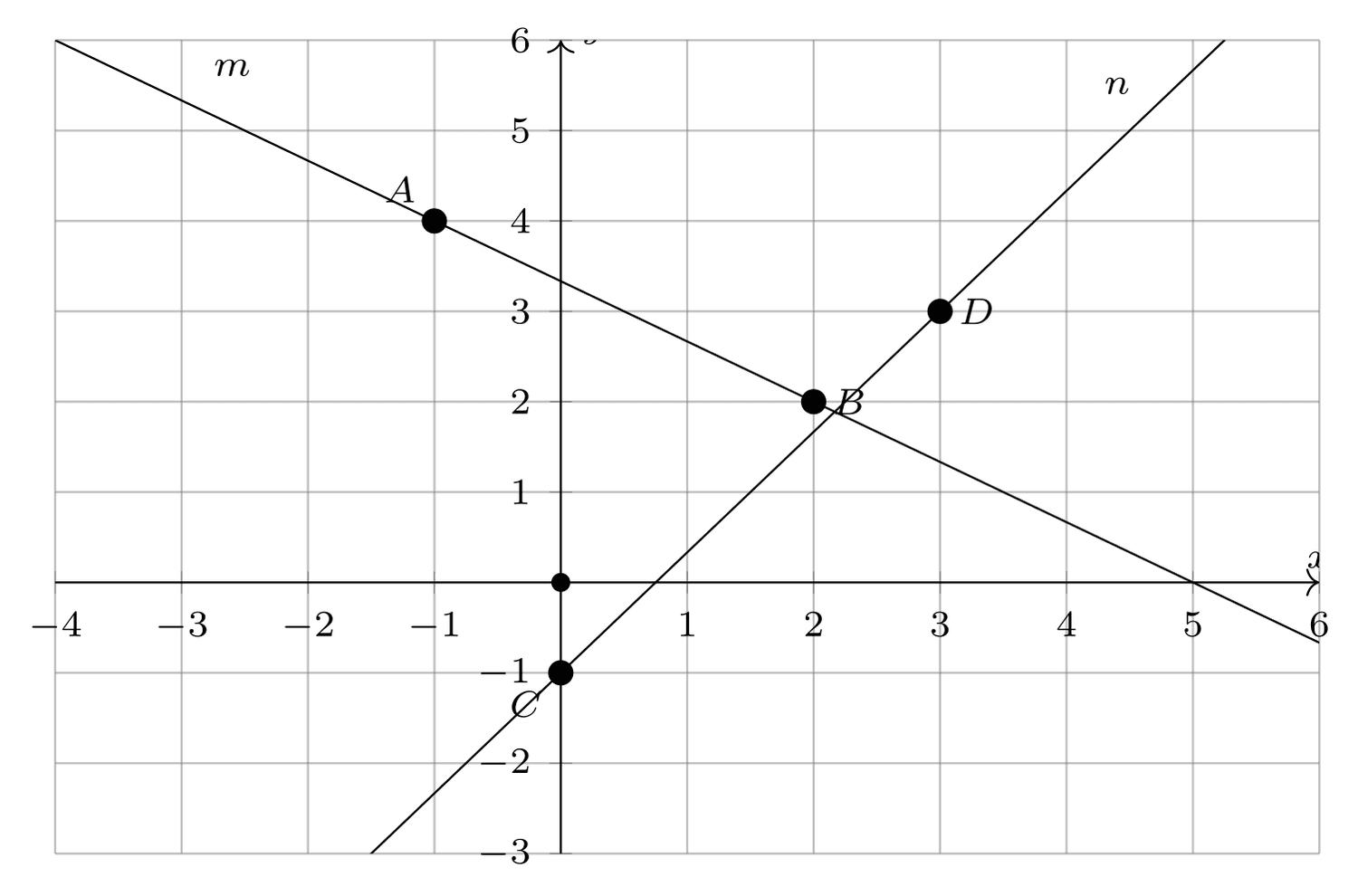
The graph shows two lines, mm and nn.

  • Line mm passes through A=(1,4)A=(-1,4) and B=(2,2)B=(2,2).
  • Line nn passes through C=(0,1)C=(0,-1) and D=(3,3)D=(3,3).
Coordinate plane showing lines m and n through A at negative 1 comma 4, B at 2 comma 2, C at 0 comma negative 1, and D at 3 comma 3.
Lines m and n pass through the four labeled points.

Which choice is the xx-coordinate of the point where lines mm and nn intersect?

First steps

  1. Line mm is y=23x+103y=-\frac23x+\frac{10}{3}.
  2. Line nn is y=43x1y=\frac43x-1.
  3. Select the intersection. Desmos shows an xx-coordinate near 2.1672.167.

Finish it

Answer choices
Calculator loads as you approach
The graph gives an approximate intersection. Match its x-coordinate to an exact choice.

Practice problems

SAT practice problems

Decide what output is required before calculating. Keep full precision, submit the requested quantity, and verify the final form.

Round only the final percent

Practice problem

At the start of a year, a company's workforce is 40%40\% engineers, 35%35\% designers, and the rest marketing staff. Engineers increase by 25%25\%, designers decrease by 20%20\%, and marketing increases by 10%10\%.

At the end of the year, the total workforce is p%p\% of the starting workforce. What is pp, to the nearest whole number?

Calculator loads as you approach
Use any convenient starting workforce, apply each change, and round p only at the end.

Recover an exact prediction

Practice problem

A line of best fit models balloon altitude, xx, in thousands of feet, and temperature, yy, in degrees Fahrenheit. It passes through (2,61)(2,61) and (11,40)(11,40).

What is the predicted altitude, in thousands of feet, when the temperature is 48F48^\circ\text{F}?

Answer choices
Calculator loads as you approach
Graph the line and y = 48, then match the approximate x-coordinate to an exact choice.

Choose the shortest exact method

Practice problem

A data set is shown below.

xxyy
1122
4477
771212

The data fit y=mx+by=mx+b exactly. What is the exact value of mm?

Calculator loads as you approach
Find the exact slope from the table first. Use regression only if you want to verify it.

Verify an exact radical choice

Practice problem

A rectangular mural has perimeter 3838 feet and area 8080 square feet. Which choice is the length, in feet, of the longer side?

Answer choices
Calculator loads as you approach
Graph the dimension conditions, select the point with the longer first coordinate, and verify the exact choice.

Finish the lesson

5 practice examples left

Finish the remaining questions correctly to complete this lesson.

Quick recap

The calculator gives evidence. You submit the answer.

  • Treat graph points and regression parameters as numerical candidates.
  • Preserve exact inputs and match approximate output to exact choices.
  • Use short algebra for a short exact route, one Desmos expression for one calculator task, and a table for repeated rows.
  • Follow explicit rounding instructions and round only at the end.
  • Prefer an exact fraction that fits when no rounding is specified.
  • Verify the quantity, condition, units, precision, and response form.

Next lesson

From geometry to coordinates to circle regression

Apply exact setup, numerical regression, exact reconstruction, and verification in one capstone workflow.

Start next lesson
Exact Answers and Rounding in Desmos for the SAT | aniko.ai